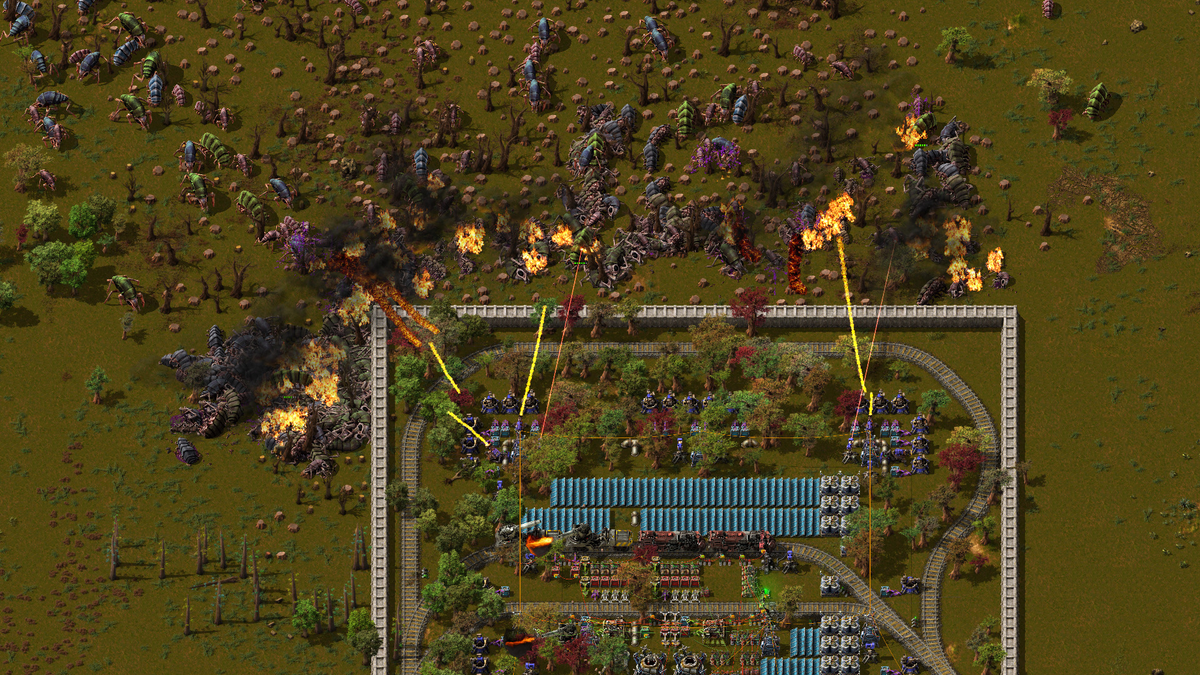
A factory in Factorio can look successful from inside its walls. Materials move, machines work and the next research project is underway. Outside those walls, the same expansion can be creating a reason for the local wildlife to attack.
That is the part of Wube Software's factory builder worth looking at closely. Production and combat share a cause. You build machinery to make more things, then have to protect the machinery and the territory it occupies. This is a source-based look at the base game's design, not a claim of firsthand testing.
The factory has consequences beyond its fence
Wube's explanation of the pollution system describes enemy spawners absorbing pollution that reaches them. After absorbing enough, a spawner contributes a unit to an attack group. The amount depends on the unit, and limits govern how quickly enemies can be sent.
The design implication is unusually direct: an industrial decision can become a military problem somewhere else. Expanding a production area means thinking beyond the space occupied by its machines. A wall marks the boundary you built; it does not mark the boundary of your factory's effects.
That makes the surrounding landscape relevant even while you are concentrating on an internal project. The interesting question is no longer simply whether you can afford another stretch of factory. It is whether the surrounding operation can support the consequences of that expansion.

Automation gives you responsibilities as well as time
The official game overview starts with manual mining and crafting, then describes the move toward automated production, power infrastructure, oil processing and robots. Those systems are not merely a more elaborate way to fill an inventory. They change what the player spends attention on.
Once machines take over a repeated job, you can work elsewhere. But the job still depends on inputs, transport and the rest of the installation. Automating a task therefore means accepting responsibility for a process that continues beyond your immediate attention. The machine has saved you labor, not removed the need to understand what you built.
Look at the belts and inserters in the screenshot below. Components travel through an arrangement with several distinct connections. Our reading of that design is that progress means learning to trust a working arrangement while knowing which dependencies would make that trust misplaced.

Pollution-driven attacks and evolution are different pressures
It is easy to collapse every enemy problem into one pollution meter. The developer's current documentation separates evolution into contributions from elapsed time, destroyed spawners and pollution. That distinction matters when interpreting what a defensive decision achieves.
Destroying a nearby nest and controlling emissions are not interchangeable ways of making enemies disappear. Nor does dealing with a local source of attacks mean that the wider evolution system has stopped. A useful reading of the game keeps those questions separate: where an attack is coming from, and how the enemy population is developing.
Wube revisited enemy targeting in its 2024 account of the underlying systems. It describes attack parties seeking a nearby local maximum of pollution and attacking emitting entities there. The relevant point for a base-game spotlight is the connection between industrial activity and danger, rather than any promise that a particular layout will always be safe.

A long development history made room for finer control
Factorio left early access on August 14, 2020. Wube's release post credited years of bug reports, mods, translations and community feedback. That history is useful context for a game whose identity depends on many small systems interacting predictably.
Later work continued to expose more control to the player. In September 2024, Wube explained new circuit connections that could read a reactor's fuel and temperature, read unmet requests in a logistics network and enable or disable logistics chests. These are specific examples of the game letting an installation react to information.
The attraction is not that everyone must build complicated control systems. It is that the game leaves room to move from doing a job yourself, to building something that does it, to deciding when that system should act. That progression gives the factory a different character from the transport-network problems in our OpenTTD spotlight.

Choose the version before planning the factory
Present-day platform information needs care. Wube announced the Nintendo Switch 2 Edition on December 22, 2025, describing it as a free upgrade with Joy-Con 2 mouse support, higher-resolution output and room for larger bases. Its announcement also confirms Space Age on Switch 2, requiring that upgrade, with PC cross-play support.
The same announcement explicitly excludes Space Age from the original Switch. The base game and the expansion are therefore distinct considerations, and a screenshot of the PC base game should not be presented as proof of an expansion feature or console performance. All images here show the base game's PC press material.
Factorio's most distinctive tension is that building capability also gives you something worth protecting. Its machinery, surrounding territory and enemies belong to the same design. For a related but different approach to engineered combat, our Warzone 2100 feature examines how a strategy game lets players assemble the fighting force itself.
Sources and platform details checked October 11, 2026. Images supplied by Wube Software through its official press kit, used for independent editorial coverage. Featured image: a defended outpost under attack, official Factorio PC base-game press screenshot.


