ZYPHER XP | CLASSIC GAME DEEP DIVE
A Warthog is a different proposition when you are responsible for the whole army. In Halo Wars for Xbox 360, sending it forward can uncover supplies, reveal a route or expose it to an enemy you have not prepared for. You are making decisions about where the fight happens before the shooting starts.
Ensemble Studios' 2009 strategy game deserves a closer look for that change in responsibility. Halo's vehicles and infantry become pieces of a larger plan, and the controller has to make that plan manageable. Our view is that the original game's strongest idea is its willingness to put limits around the battlefield. Fixed construction sites and quick selection commands give you room to think about an army without turning every order into a hunt through menus.
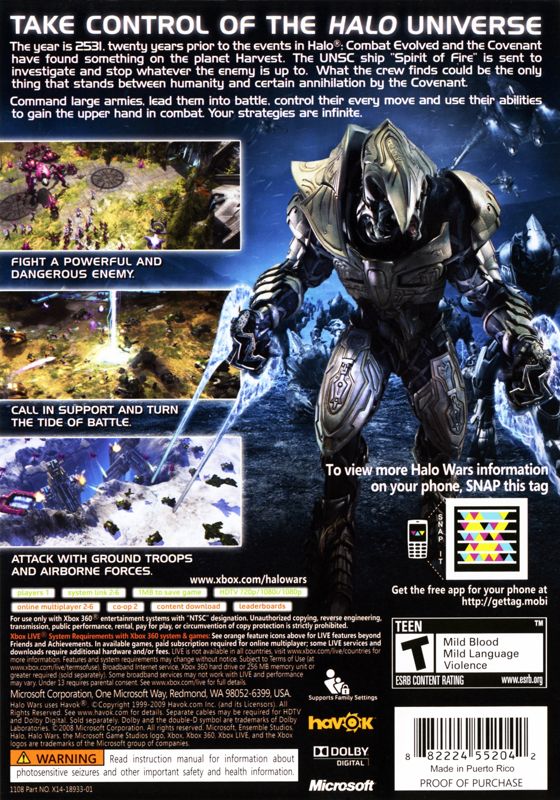
Featured visual: complete original Xbox 360 Halo Wars back cover. Its service labels and promotional text are historical packaging, not a current online-service guarantee. © Microsoft. Used with permission from Microsoft.
The controller gives you several sizes of decision
The original Halo Wars instruction manual, preserved in this manual index, describes more than a single way to grab an army. You can select a unit with A, double-tap A on a unit to select others of its type, or hold A to grow a selection circle. Separate commands select the units on screen or the units across the map. The right trigger cycles through types within a selection.
Those choices matter because “everybody go there” and “these vehicles go there” are very different orders. A global selection is convenient when you need to move a force quickly. It is less helpful when your scout has a separate job or your army needs more than one route. The type filter offers a way back from the big selection to a smaller decision.
For a returning player, that is a useful place to spend a few minutes before chasing a clever build order. Practise making the selection you intended. Being able to identify the correct counter-unit achieves little if you keep sending the entire force with it. The appeal here is direct access to the scale of the decision: one unit, one type, the nearby group or the army.
A base is a set of commitments
Halo Wars restricts construction to designated base locations, with a fixed set of building sites and turret foundations. You claim a suitable location, then choose what fills those spaces. This takes the placement question away from individual structures spread freely around the map and concentrates it on the base itself.
That arrangement makes the base easier to read, but it does not make its decisions free. Supply Pads bring resources into a UNSC base. Barracks, Vehicle Depots and Air Pads serve different production needs. A site used for income cannot simultaneously be your next production building. The interesting question is what you need the base to accomplish, rather than whether you can squeeze another structure into a corner.
Our recommendation is to read a base as a promise to your next few minutes. More income supports later spending, but you still need somewhere to produce the force you want. More production gives you options, but those options need funding. Filling sites simply because they are empty can leave you with an expensive arrangement that answers yesterday's problem.
Expansion adds another commitment. A new base can provide more space, but the manual makes the cost of losing the central Command Center explicit: the whole base goes with it. That makes defending the center more consequential than protecting an isolated production structure. A base is both an opportunity and another location you have decided to care about.

Your technology level lives in something the enemy can destroy
UNSC Reactors provide technology levels that gate units and upgrades. The manual explains that building more Reactors or improving one raises that level, while losing a Reactor lowers it. This links the technology display to actual structures on the battlefield.
That is a good reason to look beyond the resource total. Having enough supplies is only part of being ready to make something. You also need the appropriate technology and production building. The route to a desired unit can therefore involve several separate purchases, each competing with the army you could build right now.
As a design choice, this gives research a physical vulnerability. It also gives the defender a practical reason to inspect what is being attacked. Losing technology is a different setback from losing income or a production queue. Treating every damaged building as the same emergency misses what each one contributes.
A mixed army needs more than a bigger head count
The manual introduces a broad counter triangle: vehicles against infantry, aircraft against vehicles, and infantry against aircraft. It also lists specialist units, so that triangle is a starting point rather than a complete explanation of every encounter. Flamethrower squads have an anti-infantry role, for example, while the Warthog begins as a fast scout that can collect supply crates.
That distinction helps explain why a familiar Halo silhouette is useful without being the whole answer. Recognizing a tank tells you something about the force in front of you. Reading its supporting units tells you more. A recommendation to build “more units” is much less useful than asking what job the next unit needs to do.
Population adds a second constraint. The game tracks a current and maximum population, and some large units use more than one point. Once that limit matters, army composition becomes a question of what earns its space. An available production slot is no reason to keep training the wrong response.
Special attacks add another layer. Y activates them, they need time to recharge, and pressing it with multiple units selected can trigger the selected units' specials together. Our advice is to know which group you are commanding before committing that burst. A convenient button does not remove the need to choose a target.
Spartans change what an infantry unit can become
The original game's Spartans can hijack vehicles through their Jack special, with exceptions including Scarabs and Vultures. They can also take over a friendly vehicle to improve its combat abilities. The manual limits deployment to three Spartans and says they do not count against the normal population maximum.
That gives them a more interesting purpose than simply being the toughest-looking members of the army. A Spartan can be valuable as infantry, as a way to take a vehicle, or as an improvement to something you already own. The choice shifts attention from the unit's silhouette to the opportunity around it.
For us, that is a strong example of Halo Wars translating a recognizable series idea into strategy. The action becomes a decision about which asset to commit and what to attach it to. There is no need to pretend the player is personally landing every shot for the Spartan to matter.
Skirmish leaders give the same base different priorities
In Skirmish and multiplayer, the original manual gives each UNSC leader a power, a unique unit, a special upgrade and an economic advantage. Forge starts Supply Pads as Heavy Supply Pads and has access to the Grizzly upgrade for Scorpions. Anders reduces the cost and research time of unit upgrades and has the Hawk upgrade for Hornets. Cutter offers his own package, including the Elephant mobile infantry trainer and the Marine upgrade to ODSTs.
These are reasons to choose a plan, rather than a menu of interchangeable portraits. If the attraction is a leader-specific unit, remember the buildings and technology that support reaching it. If the attraction is cheaper upgrades, consider which upgrades you will actually use. A bonus becomes meaningful when it changes a decision you were going to make.
For learning the systems, we recommend an AI Skirmish with a deliberate focus: one leader, one production goal and close attention to the selections you make. Did your supply buildings fund the units you wanted, and could you select the right group when it was needed? Those are useful things to notice even when the battle goes badly.
The original still has a clear reason to command your attention
Halo Wars works as a classic to revisit because its restrictions make the strategy legible. Bases have defined spaces. Armies have a population budget. Technology depends on structures. Selection commands let you move between the whole force and a specific part of it. None of those choices wins the battle for you; together, they make it easier to see what your next decision actually is.
This analysis concerns the original Xbox 360 release. If you are choosing between it and the later version, our separate Halo Wars edition and storefront guide covers that buying question.
Put Halo Wars on your Zypher shelf
Check Zypher's Halo Wars for Xbox 360 listing for the selected copy's condition and included contents. Use the listing to establish what comes with that copy, including whether a manual is supplied.
Shop more games at Zypher, or sell your old games to Zypher when it is time to make room.
Sources checked November 13, 2026: original Xbox 360 Halo Wars manual, Operations pp. 6–15 and UNSC pp. 19–27; Xbox's original-game listing; and Xbox's retrospective for the original's 2009 release. Analysis and recommendations are Zypher editorial judgment. Packaging images retain their complete original presentation under Microsoft's box-shot guidelines. Used with permission from Microsoft. Zypher is an independent retailer.


