Zypher XP | Classic Game Deep Dive
Major Ruin gets you moving. Chilla gives you somewhere to hang on. The original Kameo: Elements of Power for Xbox 360 manual illustrates a transformation chain in which a spinning Major Ruin launches from a ledge, then Kameo changes into Chilla in midair to reach an ice wall. The interesting action happens between the two forms. Neither gets to take all the credit.
That is a useful way into Rare's fantasy adventure. Collecting another creature is only part of the appeal. Learning what happens when one creature hands a problem to the next is where the idea becomes more than a parade of costumes. Our reading is that Kameo works best as an adventure about changing your approach, with the transformations making that change visible.
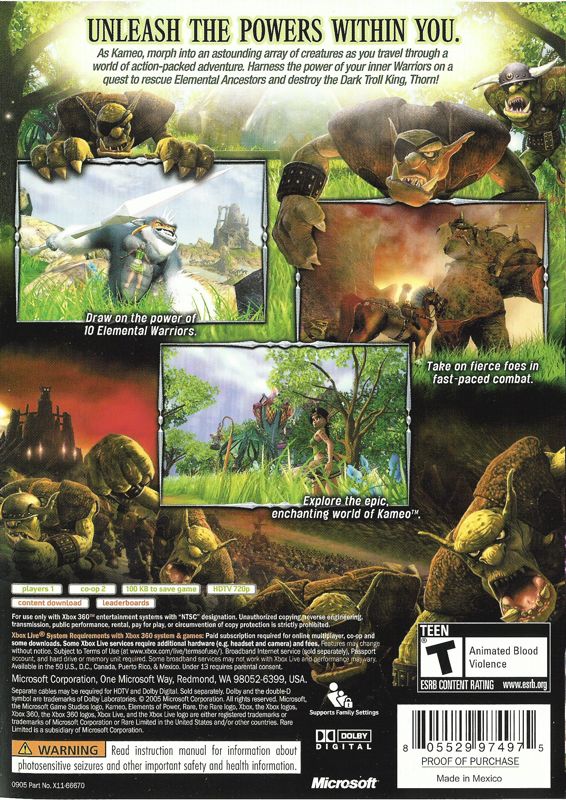
Featured image: complete North American Kameo: Elements of Power Xbox 360 back cover. Its gameplay pictures and original feature labels are historical packaging, not a current online-service guarantee. Image data credit: MobyGames.com. Used with permission from Microsoft.
A launch adventure with a different kind of star
Microsoft's November 14, 2005 launch announcement placed Kameo in the North American Xbox 360 day-one lineup for November 22. It was there beside games such as Project Gotham Racing 3 and Perfect Dark Zero, giving the new console a fantasy action-adventure among its racing and shooting showcases.
That context matters when you return to the game. A launch lineup has to introduce possibilities quickly. Kameo's central possibility is easy to understand from a picture: the heroine can become something else. The more interesting question is how a game turns that immediately legible trick into decisions worth making after the first transformation stops being a surprise.
We would judge it on that question before treating it as a demonstration of an old console. Hardware spectacle ages. A readable connection between a creature's identity and the action you need remains a useful design idea. You are choosing a way to interact with the world, rather than simply selecting the next item from a longer equipment list.
Ten Warriors give the adventure its vocabulary
Microsoft's May 2005 presentation described five elements: Plant, Water, Rock, Ice and Fire. The later Rare Replay announcement summarized the finished adventure around combat, exploration and ten Elemental Warrior transformations.
Think of the collection as a vocabulary you learn to use. A form's appearance gives it a personality, but its value comes from what it lets you attempt. The opening Major Ruin-to-Chilla example makes the point neatly: movement supplies the first part of the solution, and the next transformation gives that movement a destination.
The practical lesson is to remember relationships between forms. Knowing a favorite attack is useful. Recognizing when a different body finishes the action is more useful when the obstacle asks for it. You do not have to turn every encounter into an elaborate performance, but treating the Warriors as a connected set gives the collection a purpose beyond finding the next one.
The Wotnot Book is part of playing
The original Microsoft manual documents three assigned morph buttons, Warrior information and Ortho's hints in the Wotnot Book. Elemental Fruit unlocks advanced techniques. Warrior Focus builds through hits on Trolls and drains when the attacks stop.
Those systems give learning several places to happen. A description can explain an unfamiliar ability before a fight. An upgrade can give you another reason to revisit a form. A hint can help when you have misunderstood the situation rather than simply failed to execute an action. The book earns its place because the adventure asks you to understand a growing set of possibilities.
For a first visit, we would spend a little attention on a newly available technique before rushing to spend more Fruit. Ask what action it adds and where that action would help. That is an editorial suggestion for making the upgrade meaningful, not a claim that there is one correct purchase order. An ability you understand is easier to enjoy than a menu entry you unlocked and promptly forgot.

Combat gives the transformations a rhythm
Warrior Focus gives attacks a consequence beyond the damage of an individual blow. Our interpretation is that a rising and falling combat meter asks you to think about continuity: how the next action follows the previous one, and whether your current form helps you keep control of the encounter.
That creates a different ambition from merely possessing the largest selection. You want to know the part each form plays well enough to choose it at a useful moment. The switch itself is not automatically clever. It becomes interesting when it solves a problem that the previous action left behind.
There is room for a straightforward approach while learning. A player who is still locating the right transformation should not feel obliged to imitate an imagined expert routine. First recognize the opportunity. Then work on taking advantage of it. The resulting confidence comes from understanding the game, rather than collecting enough upgrades to avoid thinking about it.
Exploration benefits from a memorable body
The Major Ruin and Chilla sequence also explains why transformations belong in the journey between fights. The environment becomes something you can read in terms of possible actions. A ledge and a distant surface can suggest a connection once you understand the forms involved.
We find that a stronger reason to revisit this kind of adventure than a generic promise of a large world. The size of a space matters less than whether its features give you something to consider. Learning another form can change the questions you bring to a place, even before you know the complete answer.
For a returning player, try to recover that connection before looking for a complete route. Notice what appears to be blocking progress and consider which ability addresses it. If the obstacle still makes no sense, use the book's help. Wrestling with an unclear premise is not a particularly noble way to spend an evening.
Keep the original disc and later offers distinct
Kameo's release history includes more than its launch box. A March 2006 Microsoft announcement described forthcoming online co-operative options and costumes. In June 2015, Microsoft included Kameo in the announced Rare Replay lineup for Xbox One.
Those records explain why an older feature description can refer to a different moment in the game's life. They do not establish what updates are installed on a particular Xbox 360, what a used disc includes, or whether an online feature is available now. This deep dive makes no present matchmaking or fresh-installation claim.
For a physical collection, start with the platform and package you actually want. The standalone Xbox 360 Kameo release is the subject pictured here. Rare Replay is a separate collection offer. A familiar title appearing inside a compilation does not make the two boxes interchangeable purchases.
Sources and current listing checked November 14, 2026. This is a researched look at the original Xbox 360 game, with Zypher design interpretation and advice, not a new playtest. Complete box shots are resized without alteration under Microsoft's box-shot guidelines. Used with permission from Microsoft. Zypher XP is independent.


