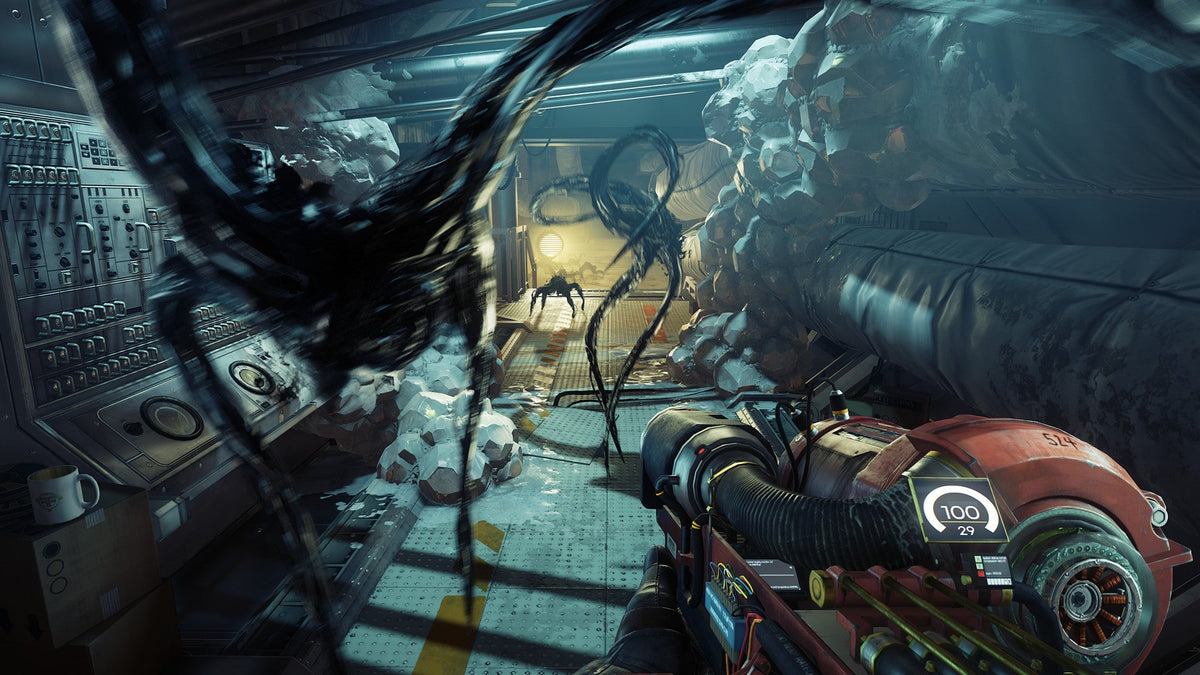
A security opening looks too small for Morgan Yu. It might be perfectly adequate for a coffee mug. Prey makes that an actual route-planning question, which is a good explanation for why its powers are more interesting than a collection of bigger attacks.
Arkane's Prey (2017) uses human upgrades and Typhon abilities to change how you read Talos I. This feature looks at the choices behind that system: what a power lets you attempt, what an upgrade changes and why the surrounding room deserves another inspection. Publisher guides provide the mechanics; the suggested ways to approach them are our interpretation.

The useful build starts with a problem in the station
Bethesda's powers guide describes a system without fixed character classes. Human abilities include Hacking, Leverage, Repair and Gunsmith, alongside three trees of Typhon abilities. You can develop the options you discover rather than choosing one class at the opening and remaining inside its walls.
That is a useful invitation to observe the station before choosing an upgrade. Notice the kind of obstacle that repeatedly interests you. If you keep investigating equipment, study the relevant human abilities. If you want a more unusual interaction with the space, look at what a Typhon power actually enables.
The meaningful comparison is between possible actions. An upgrade that helps with an interaction you want to try can be more appealing than one that merely sounds dramatic in a list. Let Talos I give the menu a context.

Mimic Matter changes what counts as a route
Bethesda's Mimic Madness feature explains the progression from small objects to more complicated machinery. A coffee mug or another suitably sized object can provide a way through a security opening. Later development allows functioning turret forms and Operator forms with their own tools.
This is where the ability becomes more than a disguise gag. The room's objects become possible answers to an access problem. A blocked approach invites you to look around for a form that fits a different route.
Our suggested experiment is to inspect the obstacle before transforming. Identify the opening, find a plausible object and decide what you want to reach on the other side. That gives the transformation a purpose beyond seeing how funny the station looks from mug height.
An upgrade also changes the question you can ask. Small-object access and taking the form of a functioning turret are different applications, even though they belong to the same ability family. Read the exact tier you have, rather than assuming a demonstration of a later form describes the first version.

Power descriptions can point toward exploration
Remote Manipulation lets Morgan retrieve distant objects and operate devices from a distance, according to the powers guide. The interesting implication is spatial: a device you can see might deserve attention even when you cannot simply walk up to it.
Look at the room from more than one position. Can you see an object or control you want to investigate? Does the power's description fit that interaction? The ability encourages a different inspection of the environment, rather than only a different way to deal damage.
This is also why the simplest first answer need not be the only appealing one. You can choose a familiar route or investigate an alternative interaction. The game becomes richer when the upgrade menu sends you back to the room with another idea.

Control, disruption and damage have different jobs
The publisher's guide distinguishes Psychoshock, which affects biological targets and suppresses psi abilities, from Mindjack, which can temporarily redirect biological enemies and free humans from Typhon mind control. Those are specific functions, rather than interchangeable labels for a psychic attack.
Before selecting an ability, decide what outcome matters. You may want to interrupt a threat, change an enemy's role in the encounter or protect somebody caught in it. That goal gives you a reason to choose among powers beyond the appearance of their effects.
For a concrete comparison, look at the target's role before spending a power on it. Suppressing an enemy's psi abilities addresses a different immediate threat from redirecting an enemy's hostility. Read the ability you have unlocked and make that distinction part of your selection.

Alien abilities change your relationship with the station
Bethesda warns that installing alien powers can make security turrets regard Morgan as hostile and increases the risk of attention from the Nightmare. The developer presents that as part of the tradeoff, rather than a reason the entire branch is unusable.
Consider whether the new possibilities appeal enough to change how you approach familiar spaces. If you want to explore that side of the system, make it an intentional part of the run. If you prefer developing human abilities, that is another coherent direction.
There is no need to disguise a preference as a universal ranking. The interesting question is which version of Morgan supports the interactions you want to investigate on this visit to Talos I.

Read the room again after an upgrade
A satisfying upgrade can change the meaning of a place you have already looked at. An opening, a device or a particular kind of threat may suggest a new approach once the relevant ability is available. Give the environment another look before treating the purchase as only a change to a number.
That is the strongest reason to approach Prey's powers with curiosity. You are choosing new questions to ask of the station. Sometimes the next useful question is whether the person-sized route was the wrong route to consider.
Zypher's Prey listing is the 2017 game for Xbox One. Check the offered copy's condition and contents; this is a different game from the earlier title sharing its name. The screenshots show the PC version. Browse Zypher's game shelves, or see our trading and selling information if you are making space for the next trip.
Sources and image credits
Images: store.steampowered.com. Full source proportions retained. Used with permission from Microsoft.


