Your employer wants an assessment of a damaged ship. The ship has returned without a visible crew. In Return of the Obra Dinn, the job description is insurance investigation. The working conditions could use a review.
Lucas Pope's mystery gives that unglamorous assignment a remarkable shape. You investigate a merchant vessel through exploration and deduction, with a pocket watch that reveals the moment someone died. Seeing a moment is the beginning of the work. Turning it into an account of what happened is the part the game leaves to you.
This feature discusses the investigation and visual design without naming solved identities or revealing the story's larger turns. The images are official promotional captures, including an unresolved book entry and unnamed scenes aboard the ship.
An employer's request gives the mystery its shape
The official premise places the returning Obra Dinn at Falmouth in October 1807, after it had been declared lost. You board as an investigator for the East India Company's London office. That is a wonderfully awkward role for a mystery: you are responsible for documenting consequences, not arriving in time to prevent them.
PlayStation's original release coverage describes the watch's access to a person's moment of death. That premise frames the visit around understanding earlier events, rather than merely looking at a damaged vessel.
Zypher's reading is that the administrative framing matters. An investigator needs more than an exciting account. A case file asks for conclusions that can be attached to particular people and events. “Something terrible happened here” is a reasonable first impression and a spectacularly incomplete report.
The book separates questions a dramatic scene can blur together
Look at the official book image below. Its record has a portrait, an unresolved identity, a recorded type of death and an unresolved attacker. Those fields are not all asking the same question. Recognizing an event does not automatically supply every missing name.

A useful approach is to separate what a scene establishes from what you are proposing. Which part of your conclusion comes from something visible or heard? Which part depends on connecting that detail to another observation? Which part is still a guess wearing a very confident hat?
That is advice for approaching the mystery, not an assertion that every clue follows one universal formula. The appeal lies in having to build a case. A quick impression can give you a direction without deserving a permanent place in your explanation.
Read the people around the obvious event
The developer's store description identifies the death scenes as freeze-frame 3D tableaux. Freezing a moment gives its composition unusual importance. A person's position, the object near them and the people sharing the space remain available for scrutiny instead of vanishing in a quick cut.

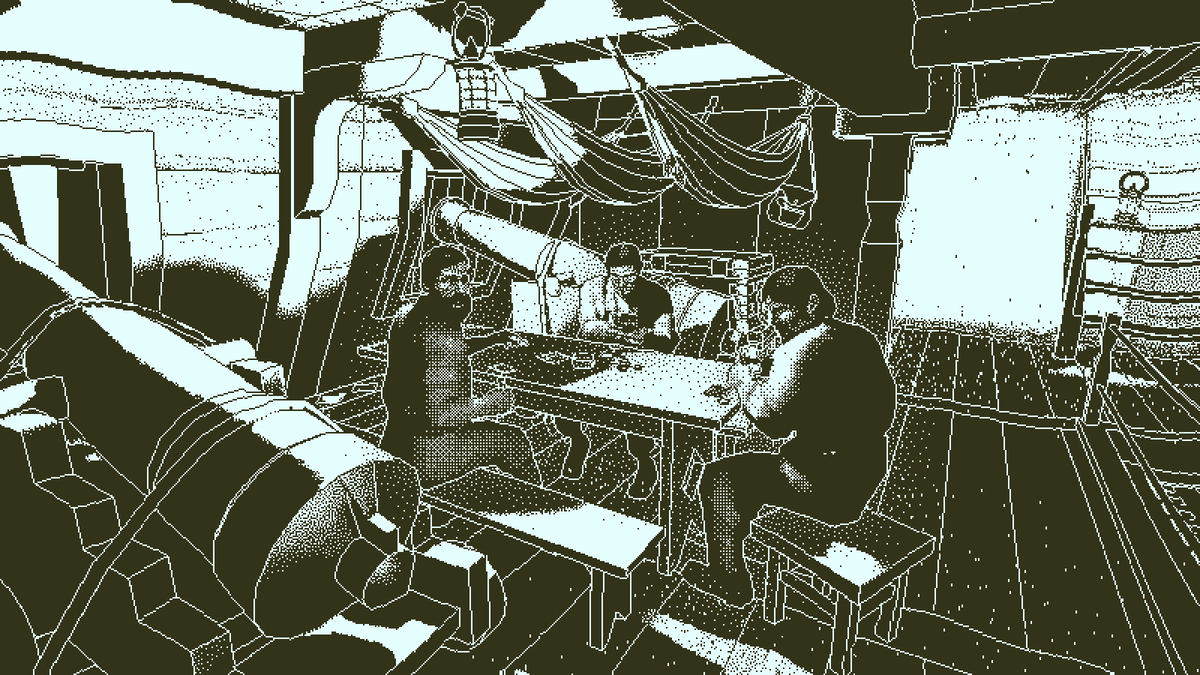
In the table scene, several figures occupy the same small space, but they are not interchangeable marks. Clothing, posture, objects and placement give you details to compare. This is an observation about the supplied image, not a claim that one outfit alone proves somebody's identity.
For a first encounter, resist letting the most dramatic object consume all your attention. Give the edges of the composition a deliberate look. A mystery can make an ordinary background detail worth remembering without putting a glowing outline around its importance.
Two colours still have to describe a crowded ship
In his 2019 account of the art direction, Pope explains that the starting point was the 1-bit appearance of games on his family's Macintosh Plus. He also describes prioritizing legibility, using geometry outlines and carefully controlled dithering rather than treating the restriction as sufficient by itself.
The distinction is visible in the capture below. The stairs, beams, rails and figures need to stay separate despite sharing two colours. The style works as more than a nostalgic surface because the player is being asked to inspect the scene. An attractive blur would be an unfortunate choice for evidence.

Audio deserves attention alongside the picture. Pope's original media notes describe it as a core component. Make room to listen rather than treating the game as a silent collection of illustrations. Choose an audio setup that lets you follow the dialogue without competing background noise.
Keep the next investigation on your shelf
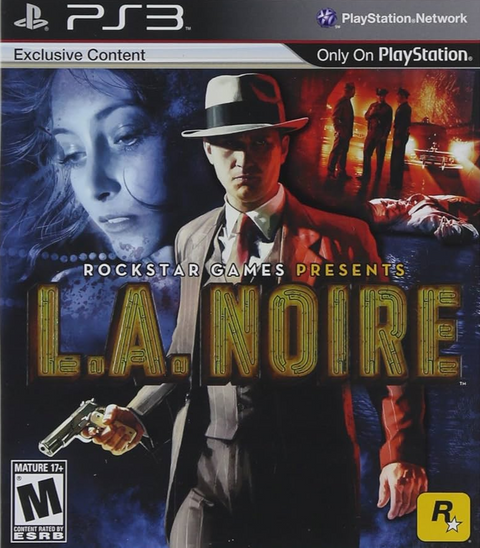
Shop Zypher for another case to work. If you want a separate detective game on physical media, check L.A. Noire for PlayStation 3 or its separate Xbox 360 listing. These are L.A. Noire editions, not copies of Obra Dinn. Check the platform, condition and included contents before ordering.
Browse Zypher's game collection, or sell your old games to Zypher when the next case needs shelf space.
Sources and official media route checked October 26, 2026. Featured and inline captures are unmodified images from the developer's official Obra Dinn gallery, used with original commentary about this game and the developer's media guidance. © 3909 LLC. This is researched analysis, not a claim of a new Zypher playthrough.