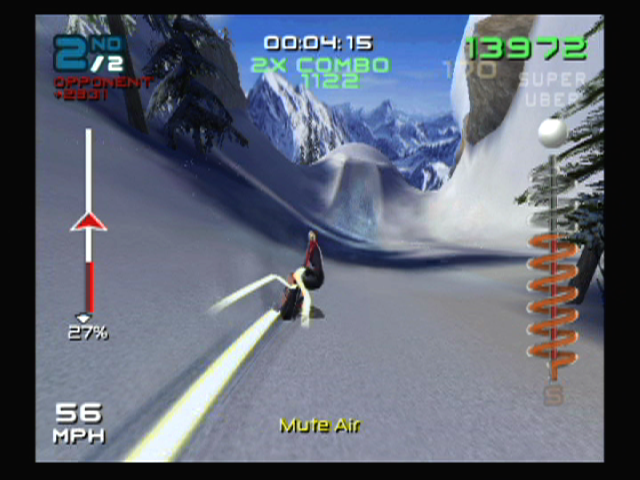
SSX 3 understands that a mountain should be more than the wallpaper behind a finish line. You can race down it, throw yourself across its rails, hunt for challenges, or ignore the event gate and keep riding. The slopes connect the competitions instead of disappearing when a results screen arrives. That turns a collection of snowboarding events into somewhere worth learning.
EA Canada's 2003 game arrived on PlayStation 2, Xbox and Nintendo GameCube under the EA SPORTS BIG label. Its central idea was unusually clear: one mountain, three peaks, and several ways to earn your way upward. The snowboarding is gloriously unreasonable. The structure underneath it is surprisingly considerate.
The next peak is a goal you can see
Conquer the Mountain is the main progression mode. The original manual identifies it as the place to unlock events and earn the cash used to develop your rider. Rather than treating every contest as an isolated destination, the game gives those contests a shared geography.
Our reading is that this makes progress easier to care about. A new peak is another part of the mountain to understand, not simply the next item on a checklist. Learning a route has value beyond one medal because the same landscape can support racing, exploration and tricks. The mountain becomes familiar without requiring every visit to have the same purpose.

You do not have to win the mountain the same way
The Peak Goals offer different routes forward. Racing and freestyle specialists can pursue medals, challenge a rival in the backcountry, then take on a Peak Race or Jam. Exploration offers another path through Big Challenges and collectible crystals. Earnings provide a cash-based route. Check the map's goal details rather than assuming every event must be cleared before the next peak opens.
That flexibility is the feature worth noticing. A player who enjoys finding side activities has a reason to keep exploring. A racer can chase a cleaner line. A trick specialist can concentrate on building scores. The game gives those preferences a place in progression instead of demanding that everyone become equally enthusiastic about every discipline.
It also makes an unsuccessful event less final. There are other things to attempt nearby, and freeriding is not wasted motion. The manual specifically describes earning cash from tricks while freeriding. Wandering around can still move a career forward.
Tricks are fuel as well as decoration
The Adrenaline Meter connects style to speed. Tricks build it, while spending adrenaline provides a boost. Its level affects the strength of that boost. It also falls over time and when you crash, so simply collecting it and refusing to do anything interesting is not a permanent solution.
This matters during races. A jump is not automatically a distraction from going fast because a successful trick can fund more speed afterward. The useful question becomes whether the move fits the available space and landing. A trick that ends face first in the snow does the opposite.

The space between jumps counts
SSX 3's combo system links tricks and board presses. Presses keep the rider doing something on the snow between aerial or rail moves, but they require balance. Fall during a combo and the accumulated combo points are lost. Repeating the same trick also produces diminishing points, so a large score needs more than mashing the same grab through every jump.
Our interpretation is that this changes how a slope looks. A rail, a patch of usable snow and the next jump can become parts of one line. The challenge is connecting them without running out of control. Slopestyle explicitly rewards finding a line that fits your skills and approach; the manual does not prescribe one correct path.
Full adrenaline also opens the door to UBER tricks, with Super UBER moves beyond them. The manual warns that these take longer to complete. Bigger moves therefore require appropriate space. The spectacle is earned through reading the terrain, even when the resulting animation suggests that the rider has misplaced several essential laws of anatomy.
Build a rider, not just a medal collection
Lodges let you buy attributes, equipment, music and additional UBER moves with earned cash. Clothing and gear customize the look, while attribute purchases develop the rider's abilities. The distinction is useful for a returning player: a mountain career is also a character-building project.

For a first session, our recommendation is to learn the jump timing and landing discipline before chasing elaborate combos. Then try more than one event type and inspect the Peak Goals. SSX 3 is generous about how you progress, but it cannot balance a board for you while you admire the score counter.
Take the mountain home with Zypher
Shop SSX 3 for Nintendo GameCube, PlayStation 2, or Xbox at Zypher. Read each listing's current condition and included items before choosing a copy. These are original console releases, so match the disc to your hardware rather than assuming a modern console accepts it.
Making room for another shelf resident? Sell your old games to Zypher. SSX 3's best invitation is still the same: learn a little more of the mountain, then find another reason to ride down it.
Sources and image credits
Researched October 25, 2026 using EA's original PlayStation 2 instruction manual, preserved as an archival scan, and EA's October 21, 2003 release announcement, reproduced by Nintendo World Report. Gameplay analysis and recommendations are Zypher editorial interpretation, not a claim of a new playthrough. GameCube screenshots, including accurately labeled menus, come from Zypher's existing catalog with credit to MobyGames under its published screenshot reuse guidance. © Electronic Arts.


