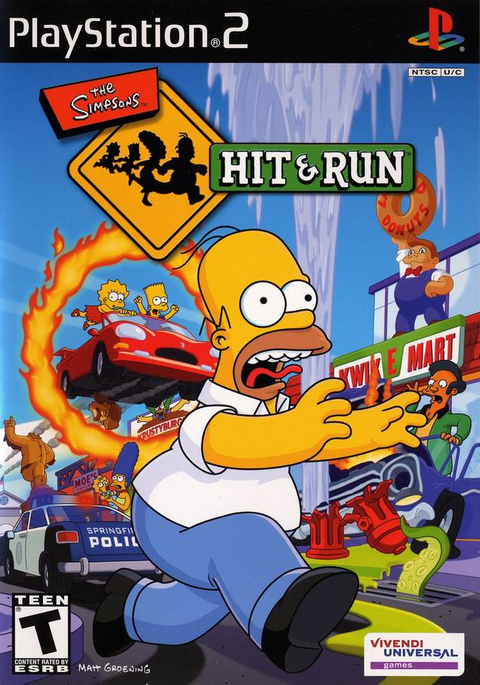
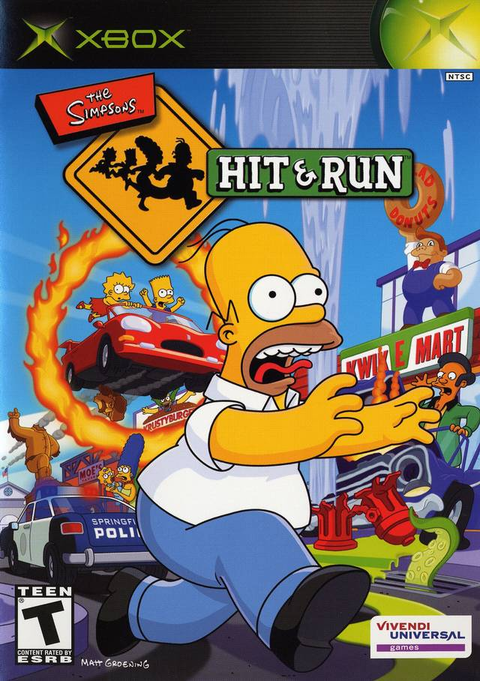
The Simpsons: Hit & Run understood that Springfield was more than a backdrop. The town was the joke, the shortcut and the reward. You did not simply drive past the Kwik-E-Mart. You stopped, kicked a few objects, found a collector card, borrowed somebody's car and left before the local police meter decided your sightseeing tour had become a problem.
Licensed games often get the faces right and the feeling wrong. Hit & Run got the feeling because it made Springfield interactive at street level. The driving mattered, but being able to leave the car is what turned a racing game into a playable episode with terrible traffic etiquette.
Getting out of the car changed everything
In a March 2026 interview with People, Simpsons showrunner and Hit & Run writer Matt Selman remembered pushing for the game to follow the freedom of Grand Theft Auto III. His specific battle was the ability to enter and exit vehicles. That sounds obvious now. It was the design decision that let the player treat Springfield as a place instead of a track.
On foot, a mission can pause long enough for the player to notice the set dressing. A shortcut can begin behind a building instead of at an intersection. A gag can live on a rooftop, beside a vending machine or inside a familiar landmark. The car gets you across town. Leaving it lets the town deliver the joke.

The map rewards recognition instead of realism
Vivendi Universal Games described the 2003 release as a mission-based driving game built around Springfield locations including the Kwik-E-Mart, the nuclear power plant and Moe's Tavern. Those landmarks are useful because players already know what they mean. The power plant is not just an industrial zone. It is Homer's workplace, Mr. Burns' kingdom and a setup waiting for somebody to make it worse.
The town is compressed and rearranged to serve missions, but that works in its favor. Hit & Run is not trying to produce a municipal survey. It is building the version of Springfield that exists in memory, where every corner can reveal a character, location or reference. The route remains readable because the buildings have identities. Nobody needs a glowing lecture to understand why driving toward the giant tire fire may be a questionable plan.

The mission structure keeps the comedy moving
The original launch announcement promised more than 50 driving and on-foot missions across five playable characters: Homer, Bart, Lisa, Marge and Apu. The variety matters less as a number than as a change of perspective. Each character belongs to a different part of Springfield, so the game can recycle roads without making every task feel like the same commute.
The PlayStation 2 manual describes street races, bonus missions, collectible cards, hidden gags, character clothing and vehicle unlocks. It also explains that mission failure is not always a dead end. Some challenges offer a skip after repeated failures, while races and wager races remain outside that system. That bit of mercy keeps the pace close to television comedy. A joke stops working when the game makes you repeat the setup twelve times because one traffic cone developed a personal grudge.
The manual also ties rewards to exploration. Collector cards unlock multiplayer tracks when a level's set is complete, bonus missions earn vehicles, and hidden gags provide their own checklist. Springfield is packed with things to find, but the rewards still point back toward driving and replaying.

The Hit & Run meter makes chaos readable
Smashing scenery, hitting objects and driving like Springfield owes you money fills the Hit & Run meter. When it reaches the limit, the police arrive. The system is simple enough to understand at a glance, which is exactly why it works. The game lets you cause trouble, then gives that trouble a visible price.
The humor comes from the escalation. A small mistake becomes property damage. Property damage becomes a chase. The chase causes more damage, because calm decision-making rarely begins after a police car enters the rearview mirror. Hit & Run does not need a realistic crime simulation. It needs a meter that says the bit has gone far enough and Chief Wiggum would like a word.
The show supplied more than a coat of yellow paint
The 2003 release announcement credits a new story written with Simpsons writers and voice performances from the original cast. That connection explains why the missions can lean on character behavior instead of generic objectives. A task involving Homer should feel different from one involving Lisa before the player even reads the goal.
The game also shipped with 49 collector cards tied to material from the television series, according to Vivendi's announcement. That is fan service with a job. The references are collectibles, progress markers and prompts to explore the map instead of decorations pasted behind the road.

A comeback is still only a possibility
Selman told People that nothing was certain about a revival and summarized his position as “never say never.” That is interest, not an announcement. No release date, platform list or confirmed remaster was attached to the interview. Until an owner or publisher makes something official, treat revival chatter as chatter.
That makes the original discs meaningful for players who want the actual game today. Hit & Run released on PlayStation 2, Xbox and Nintendo GameCube, and each Zypher listing can have different condition options. Check whether the copy is complete, game and case, custom case or disc only before ordering. A manual is a real inclusion, not something to assume because the box is yellow.
Springfield was the feature
Hit & Run lasted because it did more than imitate an open-world formula. It used freedom to make a television town playable. Cars provided speed. On-foot movement provided curiosity. Collectibles rewarded recognition. The police meter turned mistakes into escalating comedy. The pieces reinforced one idea: Springfield should be fun even when the mission marker is somewhere else.
Ready to cause responsible, entirely fictional traffic problems? Shop Zypher's in-stock copies of The Simpsons: Hit & Run for PlayStation 2, Xbox and Nintendo GameCube. Compare the listed condition and included items on each page, or sell your old games to Zypher.
Sources
- Vivendi Universal Games: The Simpsons: Hit & Run PlayStation 2 manual, checked October 25, 2026.
- Vivendi Universal Games: September 16, 2003 launch announcement, preserved by Nintendo World Report; checked October 25, 2026.
- People: interview with Simpsons showrunner and Hit & Run writer Matt Selman, published March 9, 2026; checked October 25, 2026.