WarioWare keeps handing you a tiny problem and demanding an answer before you have finished reading it. From its Game Boy Advance debut in 2003 to the motion games of Move It!, the franchise has treated understanding the next instruction as part of the challenge.
That makes WarioWare: Smooth Moves more than a collection of Wii jokes. It sits inside a longer experiment: how much can a game change when the action lasts seconds, but the way you perform that action keeps changing?
A microgame has to explain itself while it happens
The original GBA game established the compact format. Nintendo's retrospective describes more than 200 microgames, including deliberately ordinary and ridiculous tasks. The subject could change completely without requiring another sprawling adventure around it.
Our reading of that design is straightforward: recognizing the task becomes part of playing it. A brief command, a clear object and an obvious response have to do the work that another game might spread across a tutorial. Confusion is funny when the answer clicks quickly. If the picture and instruction cannot communicate the task, the joke stalls.
The small scale also makes a failed attempt easier to shrug off. The task itself is over in a moment. WarioWare can therefore ask you to look foolish with unusual efficiency. Wario would probably invoice you for the privilege.
GameCube changed the audience
Mega Party Game$! adapted the GBA microgames for television and competitive multiplayer. Nintendo's GameCube page specifies that most multiplayer modes support up to four players, while some turn-taking modes can involve up to 16. Those are different arrangements, so a 16-person headline is not a promise of 16 simultaneous controllers.
The interesting change was social. A tiny task that reads clearly to one player can also be understood by somebody watching. The room can follow the mistake before the player has finished explaining it. Moving the formula to a television gave that immediate recognition an audience, rather than simply making the original images bigger.
Twist and touch gave the sequels different jobs
Twisted! on GBA centered its play on rotating the hardware. Touched! on Nintendo DS used the touch screen and microphone. They turned the same basic short-task structure into different physical experiences.
This was a deliberate concern. In Nintendo's Iwata Asks interview, producer Yoshio Sakamoto explained that the team wanted a fresh way to play, rather than another batch of microgames alone. Director Goro Abe described the DS stylus as the direction the project needed.
That distinction helps explain why these entries have their own identities. Knowing what a scene asks is only half the task. Your hands have to translate that understanding into the input this particular game expects. A different controller can change the punchline without requiring a longer game.
Smooth Moves brought the performance into the room
The Wii entry made swinging, turning and other movements central. Nintendo's contemporary retrospective describes actions including hula-hooping, while the developers discussed how naturally the Wii Remote suited short, separate ideas.
The form instructions give those movements a little ceremony. An ordinary controller grip becomes a pose with a name, and the player has to commit to the performance. The pictured Umbrella instruction is a particularly good example: hold the Remote upright with your thumb on the button, then wait to discover what that position will mean.

That is a different kind of spectacle from watching somebody press a button. The television presents one half of the joke; the person holding the controller supplies the other. The nose-picking challenge below needs very little dramatic setup. Its restraint ends approximately there.

D.I.Y. let players build the instruction
WarioWare D.I.Y. on DS shifted attention to making microgames. Nintendo's description covers creating backgrounds, objects, music and sound effects, with interactive tutorials teaching the process. It also includes tools for music and comic strips.
Here the formula becomes a useful design constraint. A player making a tiny challenge has to decide what the audience should notice, what action should count and how the result will be understood. The simplicity is work you perform for the next person.
Keep the historical services separate from the creative tools. Nintendo's page explicitly notes that Nintendo Wi-Fi Connection ended on May 20, 2014. Its older advertising for online downloads and sharing is not a current promise attached to a used cartridge.
Gold collected the inputs; Switch split the idea again
WarioWare Gold brought 300 microgames to Nintendo 3DS in 2018, mixing returning challenges with new ones and using buttons, twisting, touch and the microphone. It is a useful survey of the series' different demands on the player's hands.
The Switch games then took distinct routes. In Get It Together!, released in 2021, you directly control characters with different abilities. Nintendo describes Wario flying with a jetpack and charging into objects. The question becomes how this character can solve the task.
Move It!, released in 2023, puts a pair of Joy-Con controllers and physical forms at the center again. Nintendo lists more than 200 motion-based microgames, two-player local co-op and separate Party Mode activities for two to four players. Check the controller requirements for the mode you intend to play.

Choose the kind of WarioWare you want to play
For quick recognition with conventional inputs, start by looking at the original GBA formula. For a television gathering, investigate the GameCube multiplayer modes. For touch input, look at Touched!; for making the challenges yourself, investigate D.I.Y. For a performance involving the people in the room, the Wii and motion-focused Switch entries offer a different appeal.
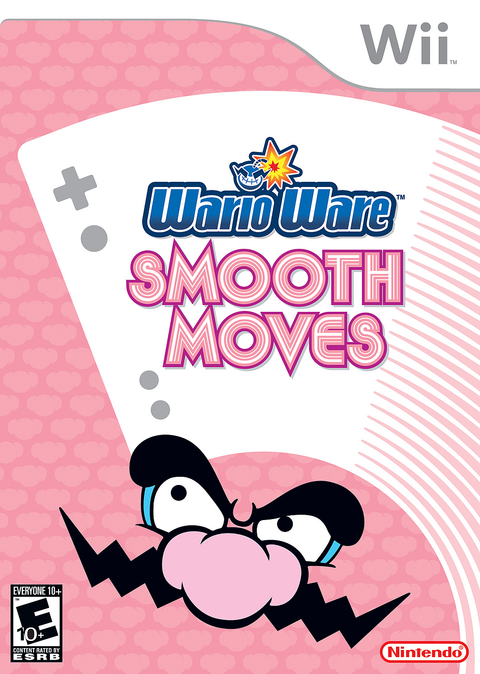
Bring the Wii chapter home: browse WarioWare: Smooth Moves at Zypher and read the listing for the available condition and included items. A game listing does not imply that a Wii Remote is included. Making room on the shelf? Use the Zypher Buy List to sell your old games to Zypher.
Sources and image credits
Nintendo's original descriptions and developer interview were checked October 25, 2026. Regional release dates are not treated as worldwide dates. Featured and inline screenshots show WarioWare: Smooth Moves for Wii, via MobyGames.