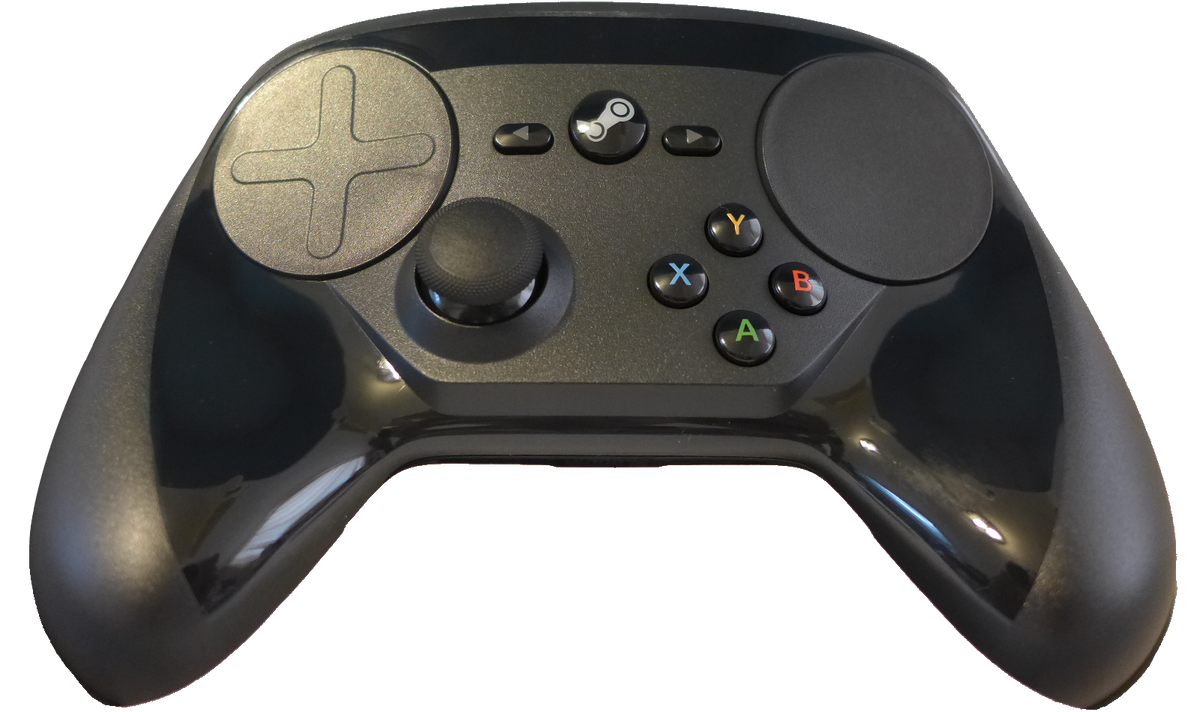
The two round pads are the giveaway. This is the original Steam Controller, the one Valve released in 2015, rather than the newer product carrying the same name. Its most interesting question was not how to add another familiar pad to a PC. It was how much of a mouse-and-keyboard game could be made comfortable away from a desk.
There is a definite ending to its retail history, but that is not the same as an explanation of every decision behind it. Separating those two things makes the surviving controller more interesting than a simple list of reasons it supposedly failed.
Featured photograph: the 2015 controller by Kenming Wang, with background cleanup by Rhain, CC BY-SA 2.0. Supplied derivative file used unchanged.
The final batch is documented. A sales postmortem is not.
In its November 2019 reporting, updated December 3, The Verge said Valve had confirmed that the remaining stock was the last batch it would manufacture. The later update recorded that stock had sold out. That establishes the original model's exit from sale, without requiring a theory about why Valve ended production.
The sources here do not establish its manufacturing costs, a sales target, or a single commercial cause. We should not turn the unusual layout into proof that buyers rejected it. A discontinued device can have design compromises without those compromises being a documented account of the business decision.

The missing second stick was the point
Valve's historical store page dates the release to November 10, 2015. Its pitch included playing PC games on a television, even games without ordinary gamepad support. Read that as the ambition of the product, not a guarantee that every game becomes effortless with it.
The official hardware documentation identifies one analog stick, two haptic trackpads, rear grip inputs and a gyroscope. The trackpads can emulate inputs such as a mouse or trackball. The triggers also distinguish a partial pull from a full-pull digital click.
That combination changes the question a player has to answer. Instead of asking only which button jumps, you can ask what a whole touch surface should do. Our reading is that the controller's appeal lies in that flexibility. It is not simply a familiar two-stick layout with a different logo in the middle.

A useful layout was part of the experience
Valve's legacy-binding documentation explains how a controller input can send emulated mouse, keyboard or gamepad commands. It also documents switching action sets or layers, which can give different jobs to controls in different situations. These are configuration tools, not a claim that a game was designed around this controller.
For an owner, the useful way to approach that freedom is with one game and one problem. Decide whether you want to move a pointer, reach a keyboard command or change how aiming behaves. Then check that job in the actual game. Trying to solve an entire PC library before finishing one working layout turns a flexible accessory into homework with handles.
That is a practical interpretation of the design, not a report of Zypher XP play-testing. It also explains why preserving the hardware alone is an incomplete goal: a working controller and a layout you understand are more useful together than either is separately.

Check the connection path, not just the power light
Valve retains an official Bluetooth Low Energy FAQ specifically for the discontinued 2015 model. It distinguishes Bluetooth from the original receiver-based wireless connection and describes firmware needed to add BLE support. The 2015 device documentation also links Valve's Windows firmware tool. Use those model-specific instructions rather than following steps intended for the newer controller.
A sensible used-hardware check therefore names the intended connection. Ask for a demonstration with the receiver if that is what is included, or with Bluetooth if that is the path you need. Do not accept “wireless” as a complete description. Then verify the controls inside the game you actually want to use, rather than treating a successful pairing screen as the whole test.
The survivor is a kit, not just a shell
The historical store listing describes two AA batteries, a USB pairing dongle and its extension dock among the original package contents. It also identifies wired use through Micro-USB. Those details provide a checklist for understanding a used listing, not a promise that every secondhand controller includes its original accessories.
Ask for clear photographs of what comes with the unit. Keep the receiver and any working configuration notes together. Our Steam Link box setup guide covers the separate streaming receiver; a Steam Link box and a Steam Controller are not the same product. Our controller-care guide covers conservative cleaning.
The original Steam Controller remains worth understanding as an attempt to change what a PC gamepad could control. Its retail run ended, but Valve's current documentation explicitly points readers to a newer Steam Controller. The accurate retrospective is about the end of this particular model, not the disappearance of the name, or proof that its central idea had no future.
Sources, model distinctions and photograph licenses checked October 18, 2026. Historical reporting is attributed above; no sales figures, internal motives, current universal compatibility or firsthand testing are claimed. The photographs document equipment and its period, rather than showing games being played.


