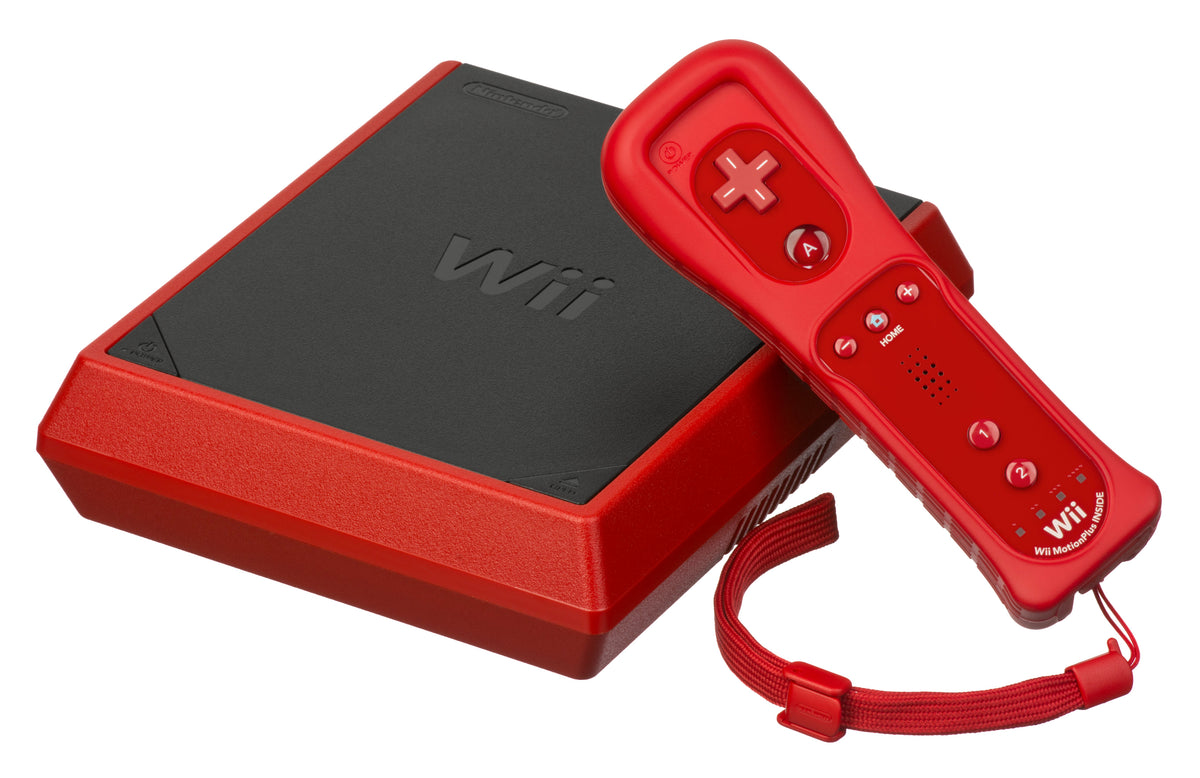
Wii mini makes a striking first impression: black lid, red shell, and a matching red remote. Then the feature list starts getting shorter. No internet. No SD card. No GameCube discs. Nintendo kept the Wii name while narrowing what the machine could do.
For this WTF Happened To...?, the interesting part is the trade Nintendo put on the shelf. Wii mini was a cheaper route into Wii games, with a smaller set of possibilities attached. Today, that makes it an unusual collector choice: appealing as a specific hardware revision, less convincing as the default Wii to buy.
Featured photograph: Wii mini with a red Wii Remote Plus. Evan-Amos, public domain, via Wikimedia Commons. The photograph identifies the hardware; it does not promise the contents of a current used listing.
The pitch was access to the existing Wii library
Contemporary reporting by Mike Rose at Game Developer, published November 27, 2012, documented Nintendo's plan to launch Wii mini in Canada on December 7. The announcement positioned the reduced-feature system toward first-time Wii buyers. That puts the machine's purpose in focus: another way into an established library.
Nintendo's own preserved UK hardware page emphasizes a family package with a red Wii Remote Plus and Nunchuk, then points readers toward familiar software such as Wii Sports Resort, Mario Party 8 and Super Mario Galaxy. Those are historical package and marketing details, not a guarantee that any used console comes with those accessories or games.
Our reading is that this was a deliberately narrow proposition. If the household wanted Wii discs and the appropriate controllers, the older library was the attraction. Nintendo was selling a different hardware package around that library rather than asking developers to establish a separate Wii mini game catalog.

The missing features changed the job of the console
Nintendo identifies Wii mini as model RVL-201. Its model comparison lists one USB port, no SD card support, and no GameCube controller sockets or memory-card slots. GameCube discs and accessories are not supported.
That last point matters for a collection spanning Nintendo generations. A buyer looking for one machine to cover Wii and GameCube games should not assume the small red Wii is interchangeable with an original RVL-001. Our Wii model compatibility guide covers that separate buying question.
The same comparison warns that Wii software requiring GameCube controller ports has compatibility limitations. So even “it plays Wii games” needs a little care. Match the exact game and required accessories, especially when a title depends on a controller connection this model does not have.
A LAN adapter cannot put the internet back
Nintendo's Wii mini internet FAQ is unusually blunt: the console cannot connect to the internet, and neither the Wii LAN Adapter nor Nintendo Wi-Fi USB Connector is compatible. Seeing a USB port on the back is not evidence that buying one more cable fixes the limitation.
This distinction is central to understanding the hardware. The missing network connection was part of Wii mini's design. It was not simply a feature that an owner forgot to configure. If a used-console demonstration stops at the Wii Menu, ask it to demonstrate the thing you intend to do, rather than filling in the rest from memories of another Wii.

The manual describes a restricted Wii experience
The North American Wii mini operations manual states that the system has no internet features, Wi-Fi, WiiConnect24 or SD card slot, and that some software features are consequently disabled. It also specifies Wii Game Discs marked for the USA, Canada, Mexico and Latin America for the hardware covered by that manual.
For a collector, those details belong beside the model number. The name on the lid cannot establish region compatibility, and an attractive imported case does not make a disc the right release for the console. Check the system label and the game together before paying.
It also changes how to judge an offer. A cheap console-only unit and a working set with the required controller, Sensor Bar and correct cables are different purchases. Ask for the included-item list and a demonstration. Treat extra parts you still need as part of your buying decision.

Wii mini still has a specific place on the shelf
Wii mini is easy to overlook because its story is about subtraction. The manufacturer retained access to a familiar disc library while excluding several functions that had helped define other Wii models. Our interpretation is that the budget pitch worked best for a buyer whose plans already fit inside those limits. It offered much less flexibility to someone whose plans might change.
Those restrictions are why this revision deserves its own description in a used listing. A generic “Nintendo Wii” offer leaves the buyer to discover the differences afterward, when returning the wrong console is considerably less fun than browsing for one.
Our recommendation today is to choose Wii mini because you specifically want this model and understand its limits. If you are still deciding which generations, accessories and software features your collection should cover, compare the other Wii revisions first. The red shell can be the reason you want one. It should not be the only fact you know about it.
Sources and image credits
Checked November 10, 2026. Sources are linked beside the relevant claims: Nintendo's preserved Wii mini page, model comparison, internet FAQ and North American operations manual; and Mike Rose's contemporary Game Developer launch report. Historical marketing is distinguished from current buying advice. No model-specific sales total, survivor count or current price is asserted.
All four hardware photographs are Evan-Amos works dedicated to the public domain on their linked Wikimedia Commons file pages. They are reproduced whole with responsive proportional display. No Nintendo game artwork or gameplay screenshot is used.