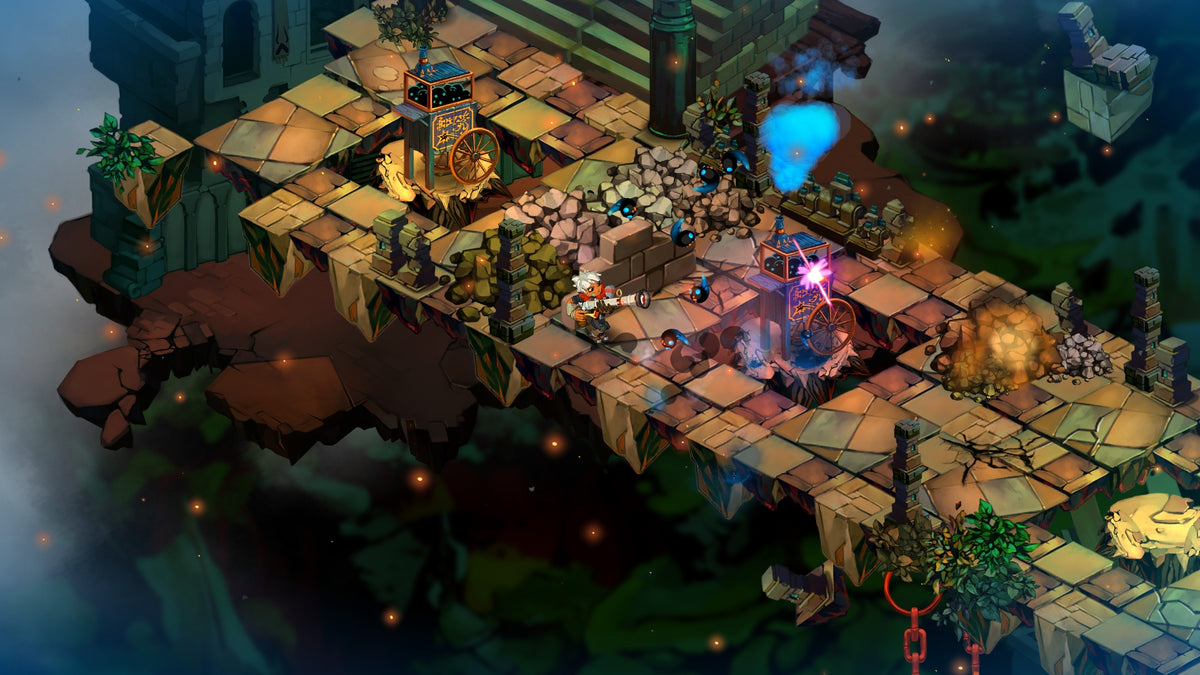
The ground in Bastion looks as though somebody has taken a beautiful painting apart and left the pieces hanging over an abyss. Then a voice starts explaining what you are doing. A small fight suddenly belongs to a much larger disaster.
Supergiant Games' first action RPG follows the Kid after the Calamity has shattered his world. He heads for the Bastion, the refuge his people were supposed to reach, and finds an old man who believes it can be rebuilt. This is a spoiler-light look at how the game makes that journey work, rather than an explanation of its ending.
The narrator stays in the room with the action
Bastion's reactive narration is its central trick: the voice responds as you move through areas, rather than reserving the story for a conversation after the fighting. Supergiant identifies Logan Cunningham as the narrator and says the recording ran to roughly 3,000 lines. You are not meant to hear the entire collection in one trip.
The useful distinction is between a narrator describing a fictional world and one acknowledging your route through it. The latter gives an ordinary action a place in the story. You can be concentrating on the immediate problem of crossing a broken walkway while the voice supplies a different scale: what this place was, what happened here, why another fragment might matter.
The voice can give a quiet stretch of path its own weight. You keep control of the Kid while somebody else supplies the sense that this place had a life before you arrived.

An arena can be a strip of surviving floor
Look at the official PC capture of a narrow tiled platform. Enemies and effects occupy a strip of ground with very little spare room around it. Elsewhere, paths thread between isolated patches of vegetation. The setting gives the action a readable boundary before anybody needs to explain a map.
For a newcomer, the practical lesson is to look at the floor as carefully as the target. Where is there room to move? Which direction leaves an escape route? A weapon can be useful on paper and still be awkward if its preferred distance does not fit the space you are standing in.
Supergiant describes combat built around movement, defense, terrain and openings. Our recommendation is to start with those questions before treating every difficult encounter as a demand for more upgrades. A route around an enemy is also a resource.

Keep a weapon because it has a job
The developer's FAQ explicitly rejects a simple ladder in which every new weapon makes the previous one obsolete. Weapons remain viable and can be upgraded and paired. That is a better reason to experiment than a steadily increasing number beside a pickup.
When trying a pair, give each half a purpose. One might be the comfortable answer when there is space to aim; the other might cover the moment an enemy closes in. Judge the combination by what happens when your preferred plan stops working. Two tools that solve the same comfortable situation can leave the same uncomfortable gap.
Keep track of the moments when you switch weapons. If one half of the pair never comes out, take that as an invitation to try something else. A new pickup has to earn its place alongside the tool you already like.

The refuge makes collecting feel less abstract
The Bastion gives the journey a destination beyond the next enemy. You are seeking materials to complete a refuge in a world whose pieces no longer belong together. The early announcement presented that reconstruction as the goal, alongside finding survivors and supplies.
That framing changes the meaning of a return trip. A hub can be a convenient place to organize menus. Here, the idea of having somewhere to return to is part of the premise. Against the floating wreckage outside, a growing refuge gives progress a physical expression.
There is a pleasing tension in that setup: the world is broken, but it is also inviting to look at. The bright greens, red fabric and warm stone in the official captures keep the ruins from becoming visually interchangeable. You can understand the desire to preserve a place before you know its whole history.

Choose how you want to approach the story
The current PC store description lists No-Sweat Mode, along with New Game Plus and Score Attack after completing the story. Those are useful options to check when deciding whether the first journey should be about reaching the next scene or chasing a demanding performance.
Bastion is single-player. Supergiant says cooperative play was prototyped and considered during development, then set aside because it did not fit the personal journey the team wanted. Do not buy it expecting a shared campaign simply because its combat looks suitable for two people.
The screenshots here are official archival promotional captures, including PC images and earlier development material. They show the game's visual language; they are not a promise that every historical HUD, scene arrangement or effect is identical in every current port.

Leave some room to listen
If you are coming from Hades, Bastion is worth approaching on its own terms. Pay attention to the shape of the ground, try a weapon combination for a concrete reason, and let the narrator finish a thought before the next menu steals your attention.
The strongest reason to revisit it is the relationship between those things. A small figure crosses a fragile piece of landscape, makes a choice in a fight, and hears that choice folded into a story about a world worth rebuilding. That is a specific pleasure, even before you know where the road ends.

Find your next game at Zypher
Browse games at Zypher Trading Video Games for your next shelf addition. Check the platform, edition, selected condition and included items on each listing before buying.
Making room on the shelf? Check Zypher’s Buy List and sell your old games.
Sources and image credits
- Supergiant: Bastion FAQ
- Developer-published PC description
- Original announcement and media invitation
- Official playable-build screenshots
Sources checked November 16, 2026.


