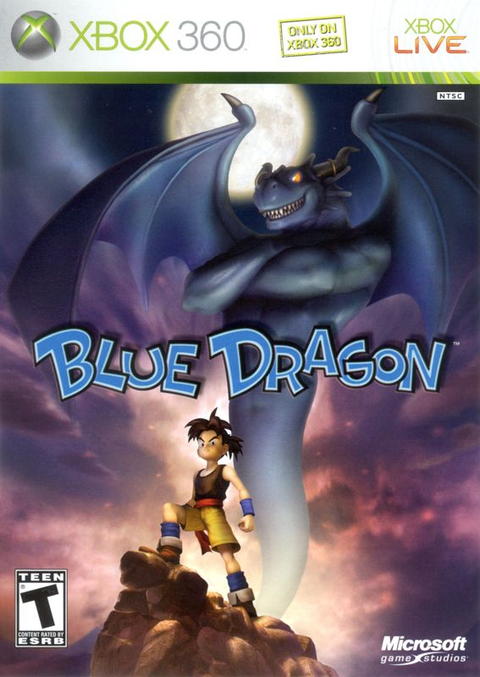
The big blue creature does the dramatic part. The small row of portraits tells you what might happen next. Blue Dragon for Xbox 360 puts those two ideas on the same battle screen: an expressive fantasy adventure and a turn-based system that rewards looking past the attack animation.
Shu and his companions control Shadows that perform their combat actions. Microsoft’s current game description identifies five young heroes, character design by Akira Toriyama and music by Nobuo Uematsu. Those credits help explain the initial appeal. What gives a return visit some substance is the freedom to shape what the party can do.

The battle menu deserves as much attention as the creature
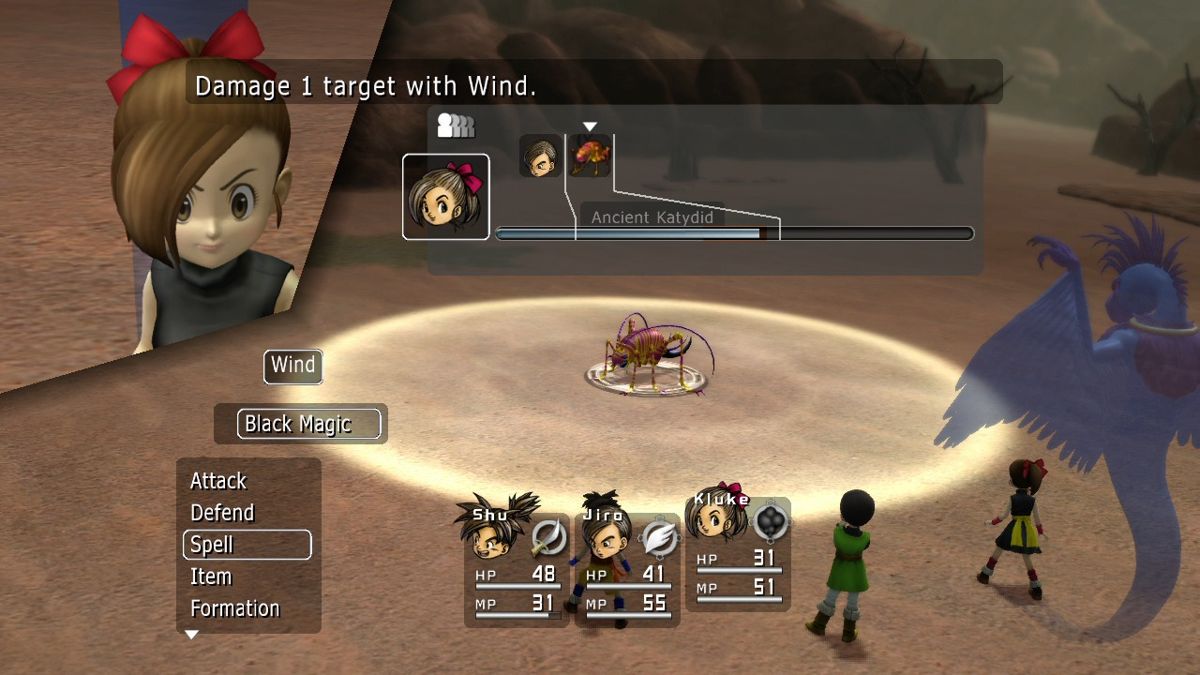
Blue Dragon’s interface makes the party and the sequence of actions visible around the battlefield. In the screenshot above, Wind magic is selected while portraits and a charge interface remain on screen. That information is part of the decision, rather than decoration around it.
Kevin VanOrd’s original August 2007 GameSpot review describes charged actions whose availability depends on equipped classes and skills, with charging potentially changing the turn order. It also documents the ability to change classes outside battle and carry many learned spells or skills between them.
The useful consequence is that a stronger-looking action is not automatically the right action at every moment. Consider what the party needs before the next enemy response. An immediate result and a delayed result can solve different problems, even if the delayed one promises more power.
That is our recommended starting point for reading the interface: look at the next few portraits before committing, then check what changed. You are learning the relationship between the command and the sequence, rather than only watching the number that appears at the end.

Class freedom makes preparation matter
A flexible class system gives you more control over the party’s responsibilities. It also gives you more opportunities to assemble a group that can do plenty of interesting things while neglecting the one job an encounter needs.
Before a difficult stretch, think about the party as a group of available answers. Who can provide recovery? Who has the action you expect to use against several enemies? Which character is learning something you want to retain? Those questions are more useful than choosing five class labels independently and hoping they add up.
The appeal here is not that every character must remain fixed in one narrow role. It is that you can make a deliberate change. Keep the rest of a familiar arrangement while trying a new class or learned skill. You will have a clearer view of what that change contributes than if you rebuild the whole group at once.
There is a tradeoff in that freedom. A player who loves strongly fixed party identities may prefer an RPG where the cast’s mechanical roles are less flexible. For somebody who enjoys assembling a toolkit, the ability to move skills around is part of the attraction.

Seeing an enemy changes the walk toward it
In Greg Mueller’s report on Sakaguchi’s March 2007 demonstration, enemies were visible in the field before contact triggered a separate battle. The demonstration also showed field commands, including a way to paralyze enemies and a barrier used against lower-level creatures.
That creates a decision before the battle menu appears. An enemy is a thing you approach, avoid or prepare around. The scenery between encounters has a tactical purpose because the next fight has a location.
Watch where that transition happens as you approach a creature. Decide whether you want the encounter and enter it with an intention. The field and battle screens are different spaces, but the choice to move from one to the other still belongs to you.
It also makes exploration and combat feel connected without making them the same activity. You can appreciate an area’s scale and routes, then switch into a more deliberate pace once the fight begins. That separation is a large part of the classic RPG rhythm.

Read the targeting description
The row-targeting description in the screenshot above is a good example of information that is easy to skip while chasing a dramatic animation. An action’s shape matters as well as its apparent strength.
Look at which targets are selected, then compare that with what you intended. If several opponents are lined up, an action described around a row asks a different question from one aimed at a single enemy. You do not need a spreadsheet to benefit from reading the line the game has already put in front of you.
A sensible early habit is to make one conscious targeting decision in each unfamiliar battle. Notice the target marker, the action description and the visible order. Once those checks become comfortable, the menu stops feeling like an interruption and starts feeling like the place where the fight is actually organized.

The presentation gives a slow decision room to breathe
Blue Dragon’s compact characters, oversized Shadows and colorful environments make its battle roles easy to recognize in a still image. The party remains visible beneath effects that can occupy much of the screen. Our reading is that this contrast helps the game hold onto a friendly adventure identity while its menus do more detailed work.
It is a different pleasure from a combat system built around continuous reactions. You can stop to consider what the next action should be, then watch the chosen creature perform it. The spectacle is a response to a decision you already made.
That pacing will suit some evenings better than others. If your favorite part of an RPG is choosing a party’s capabilities and making sense of the next encounter, Blue Dragon offers plenty to inspect. If you want constant movement to carry every exchange, choose it with the turn-based structure firmly in mind.

Choose the copy, then choose the party
The original physical Xbox 360 release spans three DVDs, as documented in GameSpot’s contemporary review. Check the actual offered set before buying a physical copy. A standard listing does not establish that separate downloadable extras or unused codes are included.
Xbox’s current digital listing also identifies Xbox One and Xbox Series X|S support. A digital purchase and an older physical set are different ways to own the game; match the format to the hardware you intend to use.
See Blue Dragon at Zypher for the currently offered condition and contents. If the next RPG needs shelf room, start with our general sell-your-old-games page.