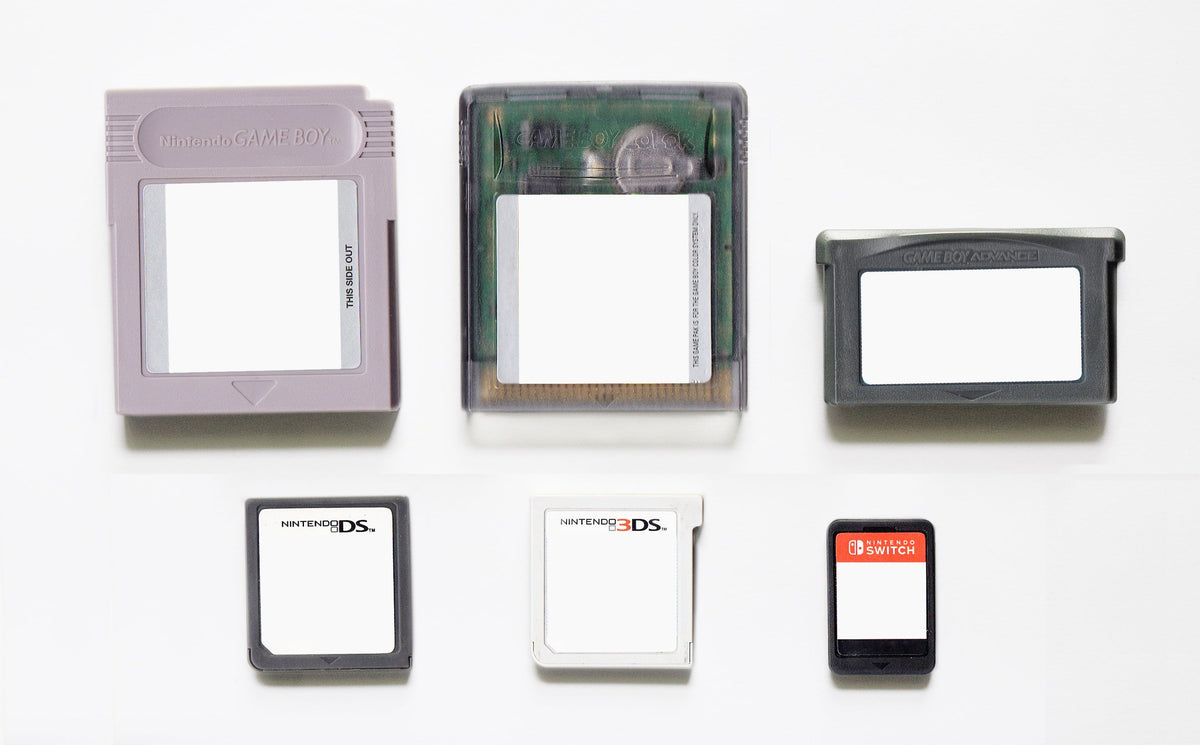
A physical game can be a cartridge full of code, an optical disc that installs most of its data, a tiny game card, or a boxed object that mainly proves you are allowed to download something. Those formats all belong on a shelf, but they do not preserve the same parts of a game.
This is not another physical-versus-digital verdict. The useful question is narrower: when you keep the object, what exactly are you keeping? The answer affects what collectors inspect, what future players may still need, and why two equally tidy cases can represent very different kinds of ownership.
Cartridges made the game and the object feel inseparable
Classic cartridges made physical ownership easy to understand. The software lived on read-only memory inside a proprietary shell. Put the cartridge into compatible hardware and, barring damage or an unusual accessory requirement, the object was the game.
That design also gave each platform a visible identity. A Game Boy cartridge, a Nintendo 64 cartridge and a Game Boy Advance cartridge are not anonymous storage devices. Their shapes, labels and contacts tell a collector which family they belong to before a console is even switched on.

Cartridges are not indestructible. Dirty contacts, cracked shells, failing batteries in some older games and careless storage can all cause trouble. Still, the basic ownership model is refreshingly literal: protect the object and compatible hardware, and you preserve a meaningful portion of the original experience.
Optical discs changed the economics and the weak points
CDs, DVDs and Blu-ray-based game formats traded the cartridge shell for inexpensive, high-capacity optical media. That helped games grow while giving publishers room for full-size cover art, multi-disc sets and elaborate special editions. It also changed what collectors need to inspect.
The readable surface can collect scratches and residue, while cracks, label-side damage and deterioration inside the layers are separate problems. A clean-looking disc is not automatically readable, and a disc with ordinary surface marks is not automatically dead. Our disc scratches versus disc rot guide explains why those failures should not be lumped together.

Modern discs can also blur the old idea that every byte must remain on the object. Depending on the game and platform, the disc may provide install data, prove access, or work alongside updates and downloadable content stored elsewhere. The important phrase is depending on the release. Collectors should check the exact platform, region and edition instead of turning one awkward example into a rule for an entire console generation.
Game cards made physical libraries pocket-sized
Game cards bring the cartridge idea into a smaller form. They are easy to store and resistant to the surface scratches that worry disc collectors, but they are also easy to lose. A loose card offers very little room for edition details, so the case and label do more identification work.
The Nintendo Switch family also shows why a familiar shape is not enough. A standard card can carry game data, while a Switch 2 game-key card authorizes a download and must remain inserted for play. Nintendo says the latter can be loaned or resold and is not tied to one account, but it is not a self-contained copy. See our Switch 2 game-key card guide for the format-specific setup and storage details.

What the object preserves well
A physical copy can preserve a transferable artifact. For releases that are not account-bound, the disc or card can move between compatible systems and owners. That supports lending, resale and the used-game market in a way an account license generally does not.
The package preserves history that software files do not: cover design, legal text, regional ratings, manuals, maps, inserts, registration cards and sometimes wonderfully unnecessary bits of cardboard. Those pieces explain how a game was presented to its first audience. Our condition guide separates complete-in-box, game-and-case and loose-copy expectations without pretending every release included the same materials.
The media may also preserve a specific launch-era build. That can be useful evidence of what shipped, but it is not automatically the best or complete version. Patches can repair bugs, add features or change balance. Preserving the object and preserving every later state of the software are related jobs, not identical ones.
What the object cannot guarantee
A cartridge, disc or card cannot preserve a service that ran on someone else's servers. It cannot turn an expired download code into reusable content, restore delisted DLC, or guarantee that an account-based entitlement will transfer. Microsoft describes its digital goods as licensed rather than sold and generally restricts transfer or resale of those licenses.
Save data may live somewhere completely separate from the game object. Nintendo says Switch save data is stored in system memory, and compatible titles can use Nintendo Switch Online cloud backup. Sony's PS5 backup guidance similarly treats games, apps, saves, captures and settings as console data that can be backed up and restored under platform rules. Keeping the disc safe is sensible; treating it as a complete backup plan is not.

A practical collector check before buying
- Confirm the exact platform, region and edition. Similar artwork can hide different languages, ratings, disc counts or content.
- Identify what carries the game. Is it a self-contained cartridge, an install disc, a play disc, a key card or a box with a code?
- Check every included piece. A case, manual, map, bonus disc or unused code should never be assumed from the word physical.
- Look for required downloads or online features. Packaging and the publisher's current support information are better evidence than a seller's shorthand.
- Inspect condition for the actual format. Cartridge contacts, optical surfaces, center hubs, card labels and cases have different failure points.
- Protect saves separately. Learn the console's local and cloud backup rules before a hardware failure makes the lesson expensive.
The shelf is evidence, not a time machine
Physical games matter because they keep software connected to objects people can inspect, exchange and preserve. They also keep the commercial history around a game visible. That is more than nostalgia, but it is not magic.
A good collection records what each object actually does. Some copies contain a largely self-contained game. Some preserve a particular build plus a license check. Some preserve packaging and transferable access while the software lives elsewhere. Knowing the difference turns a shelf of boxes into a more honest archive.
Browse Zypher's current physical game inventory, or check the Buy List before selling games to Zypher.
Official sources and image credits
- Microsoft digital goods usage rules
- Nintendo Switch Online overview
- PlayStation support: back up and restore PS5 data
- Nintendo's explanation of Switch 2 game-key cards
Featured image: Nintendo cartridges and game cards by Derrick Rossignol via Wikimedia Commons, CC BY-SA 4.0. Inline image credits and licenses appear beneath each image. Images are presented without editorial alteration beyond responsive display sizing.


