The credits are a perfectly reasonable place to stop in Celeste. Coming back for a tougher movement problem is a different commitment from coming back for more story. The game's optional challenges make the distinction useful, especially once the later Farewell chapter enters the picture.
For this classic deep dive, we're looking at the 2018 platformer's extra climb: what B-sides contribute, why a demanding bonus chapter can become more than a difficulty extension, and how to choose a return trip that actually suits you. There are light structural spoilers about Farewell's development below, but no ending explanation or room-by-room solutions.
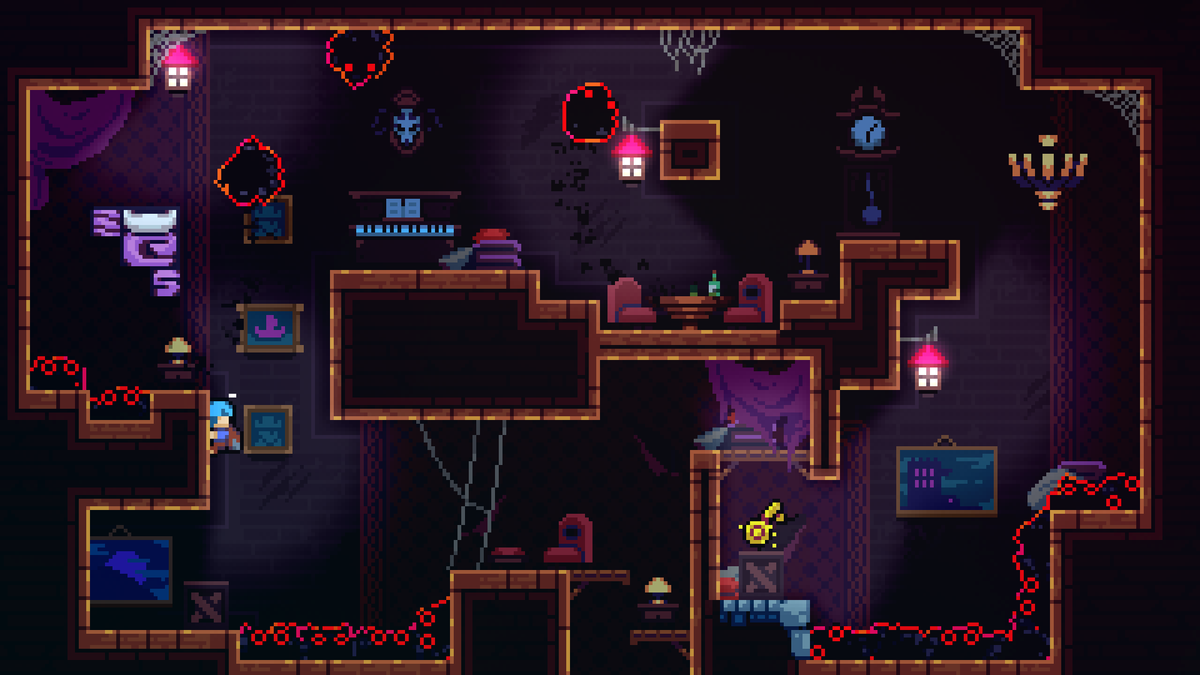
Featured image: a dark room with red hazards in an archival Celeste screenshot. It illustrates the original game's obstacle layouts, not a specific B-side or Farewell room. © Maddy Makes Games, supplied by Noel Berry. Source image, CC BY-SA 4.0; image unaltered.
A harder chapter changes the reason to play
The developer's PC listing identifies B-side chapters as unlockable challenges. That gives the harder material a job of its own, beyond extending the route through the main story.
During the central journey, reaching the next location carries a narrative incentive. Returning for an optional challenge shifts attention toward the movement itself. The attraction can become executing an awkward sequence cleanly, recognizing a route through crowded hazards, or finding out how far familiar actions can stretch.
That shift can be appealing without being compulsory. If you mainly wanted to follow Madeline's story, your interest may change once a challenge asks for much more precision. If you enjoy demanding platformers, the opposite may happen: the extra material is where you want to spend most of your time. Treat that as a preference, rather than a verdict on whether you finished the game properly.

The move list stays short; the commitment gets longer
Celeste's core actions are jumping, air-dashing and climbing. The interesting part of a demanding route is how those actions have to cooperate. A dash can reach an immediate destination while leaving an awkward approach to whatever follows. A comfortable-looking surface can be less useful than the position needed for the next action.
For an optional challenge, our recommendation is to read beyond the first obvious landing. Look at where a successful opening would leave Madeline. Then consider the next direction you would need. This is planning advice, not a universal solution: some obstacles need observation in motion before their timing makes sense.
Separate recognizing a route from executing it consistently. If the route is unclear, practicing the opening endlessly may be answering the wrong question. If the route is understood, changing the plan after every mistake can make consistency harder to judge. Decide which problem you are working on before turning another attempt into an improvised tour of the spikes.
Read a crowded room in passes
The featured dark-room image gives you a concrete way to practice looking. Madeline is on the left, a yellow key sits lower and farther right, and red circular hazards interrupt the space between the platforms. Start by identifying surfaces you could stand on. Then identify the hazards separating them. Only after that, consider a possible sequence of movement.
Those are separate observations. The key tells you that something interesting is over there; it does not tell you which approach will be safe. The open middle of the room looks generous until you account for the red hazards. The still image also cannot settle how those hazards move, so a plan drawn from it is a starting hypothesis, not a verified route.
Apply the same distinction while playing. First read the space, then observe the moving pieces, then commit to a route you can describe. If an attempt fails, identify which of those three readings was wrong. That is more actionable than deciding you are simply bad at the entire game. Even a very busy Celeste room becomes easier to discuss once you name the particular obstruction.
Farewell began as a much smaller extra
Maddy Thorson's development account describes an initial plan for roughly 30 to 50 very difficult screens without an explicit story. Super Mario World's Special Zone was an inspiration. The project grew into a full chapter as the team decided it needed a new narrative destination as well as mechanical challenges.
Our reading is that Farewell offers a different incentive from a purely technical challenge. You may want to see its story continue while still finding the movement demanding. Interest in one part does not automatically make the other part comfortable.

A new chapter is not another set of B-sides
The September 2019 announcement presented Farewell as a free story chapter with more than 100 new levels, new mechanics and new music. It also specified that Chapter 9 has no B-side or C-side of its own. This is historical context, not a new update announcement.
That matters when deciding what to expect. Farewell is a chapter with its own progression, not an additional difficulty setting to apply across every earlier level. You can be interested in the extra story without assuming it will feel like simply repeating the main climb.
The making-of account also explains that the team used a heart gate to separate a difficulty spike. That helps distinguish starting the chapter from being prepared for everything beyond its opening. An opening that introduces a new object can be welcoming while the later sequence demands much more confidence with it. Judge your readiness by the movement the chapter asks of you, rather than treating access to its first room as proof that the whole trip will suit you.
Use a return visit to choose a specific goal
A useful session can have a narrower goal than completing an entire chapter. You might want to understand one unfamiliar obstacle, reach a particular stretch comfortably, or see whether a control arrangement still suits your hands after time away. Pick the goal before the session becomes a negotiation with the clock.
There is a practical difference between stopping because you are finished for the evening and stopping because the game has beaten you. The first is an ordinary decision about attention. An optional challenge can remain available without becoming an obligation to spend the rest of the night on it.
For controls, use our separate Celeste PC settings guide if the physical input is the problem. That article covers documented binding options. Here, the recommendation is simpler: identify whether you are trying to solve a route, practice execution or make the controls more comfortable. Each gives you a different next step.

Choose the challenge for what it gives you
Celeste is a single-player platformer, so this extra climb does not need to be negotiated with a co-op partner. That freedom is useful. You can pursue the hardest material, return to familiar areas, or leave the mountain alone for a while without holding up someone else's session.
The strongest reason to revisit is a specific curiosity: an optional route you want to understand, or a chapter whose combination of story and movement interests you. A completion percentage is a much weaker explanation for an evening you are no longer enjoying. Our earlier Celeste feature discusses the basic retry structure; the extra climb asks what you want to do with that structure after the main journey.
Find the next game for your Zypher shelf
Shop Zypher Trading Video Games for your next physical game. Browse our game selection and check the platform, condition and included contents on the actual listing. For Celeste itself, use the developer's platform links to check the edition available for your hardware.
Making room for something new? Sell your old games to Zypher. Source and media checks completed November 11, 2026. Design judgments and session-planning suggestions are Zypher editorial interpretation; no firsthand playtest is claimed.


