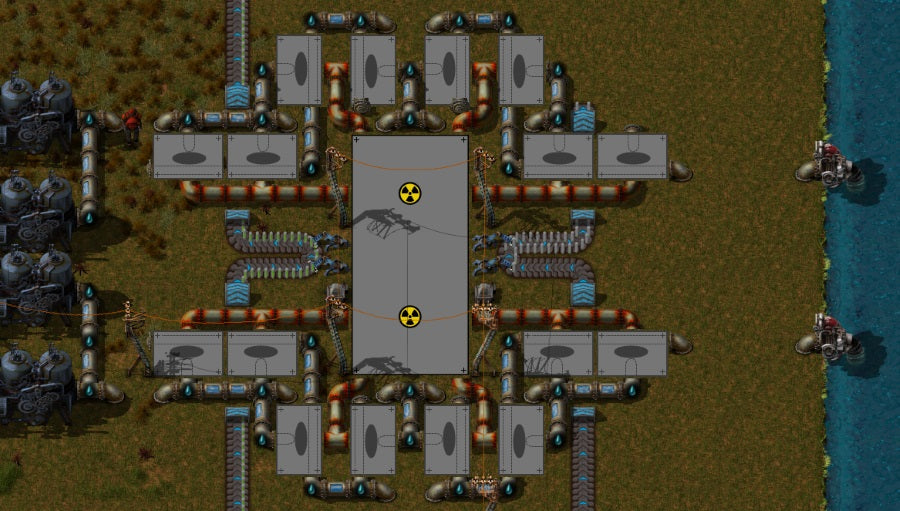
Before Factorio's nuclear power had its finished machinery, Wube showed reactors that looked like large gray placeholders linked by bright red pipes. The developer said that was exactly what they were: temporary graphics for a system still being prototyped.
The January 13, 2017 development post is interesting for more than the unfinished appearance. It records a decision to leave out planned cooling towers and a closed water cycle. Even in a game famous for inviting players to build elaborate production chains, another layer of machinery still needed to justify itself.
This is a look at Factorio's pre-0.15 development, not a current reactor blueprint. Every image below comes from that specific Wube post. The placeholder machines, layouts and old interface are historical evidence of the prototype, not instructions for copying a modern power station.
More simulation was not automatically a better next step
Wube's stated reasons for cutting those planned systems were practical. Moving into nuclear power already represented a large jump for players, and the graphics team also had plenty to complete for version 0.15.
That is a useful distinction between a feature being conceivable and being a good fit for the transition being designed. Adding cooling infrastructure could have created another set of logistics. It would also have added another thing to understand before the new power source felt usable.
Our reading is that the decision protected the shape of the upgrade. Nuclear power could still feel like a meaningful engineering project without every possible complication becoming part of the entrance exam. The reasons Wube actually documented were the player's learning jump and the graphics workload.

The production chain still had room to become a project
The same prototype account showed uranium mining and processing before moving on to reactors. That sequence is worth noticing even without borrowing its old recipe numbers. The power plant was one part of a wider factory problem, not simply a generator placed at the end of a research unlock.
The mining capture shows belts and drills arranged around a deposit. The processing capture puts machines and material movement between the ore and the intended result. Those images make the scale of the transition more concrete than a picture of one reactor alone.
If you enjoy Factorio for the moment when one production goal turns into several connected jobs, there is already plenty to recognize here. A system can create interesting dependencies without also needing every additional piece of simulated infrastructure its subject suggests.

Adjacency made the layout itself a decision
Wube's prototype illustrations progress from a single reactor to connected pairs and a larger group. The point was not merely that a bigger structure would make more power. The post described an output bonus for neighboring reactors, making the arrangement part of the engineering question.
The current reactor documentation still describes a neighbor bonus, while modern nuclear generation passes heat through heat exchangers to produce steam for turbines. That continuity is useful context, but it does not turn the 2017 placeholder diagrams into current-build specifications.
Look at the bright red connections in the paired-reactor image as a piece of development communication. They make the intended relationship visible even before the final art exists. The machinery is unfinished, but the question the player will face is already recognizable: how should the pieces fit together?


Read an old development image on its own terms
An archival screenshot can be genuinely informative and still be the wrong reference for a present-day build. Here, the conspicuous placeholders are part of what makes the source useful. They let you see the developer demonstrating the system before the presentation was complete.
For a current factory, consult the current entity documentation and the values shown in your installed version. For understanding how the feature took shape, keep the old images attached to their date and explanation.
Wube's 2017 post left open the possibility of adding the omitted systems later. It is a development snapshot of what the team chose to build for that transition, rather than a promise about what a future expansion would contain.

Build a different kind of collection
For games away from the factory, shop Zypher’s physical game selection. Have older titles ready for a new home? Use Zypher’s general Buy List to check the exact games and systems you own.
Sources and image credits
- Wube: Friday Facts 173, January 13, 2017
- Current official wiki: Nuclear reactor
- Current official wiki: Heat exchanger
- Wube: website-asset permission for game coverage
All five screenshots come from the January 2017 Wube development post and show pre-0.15 prototypes, including placeholder graphics. They are unaltered and used for independent editorial coverage under Wube’s website-asset permission. Historical layouts and recipes are not current-build instructions. Sources and store links checked November 15, 2026. No publisher endorsement is claimed.


