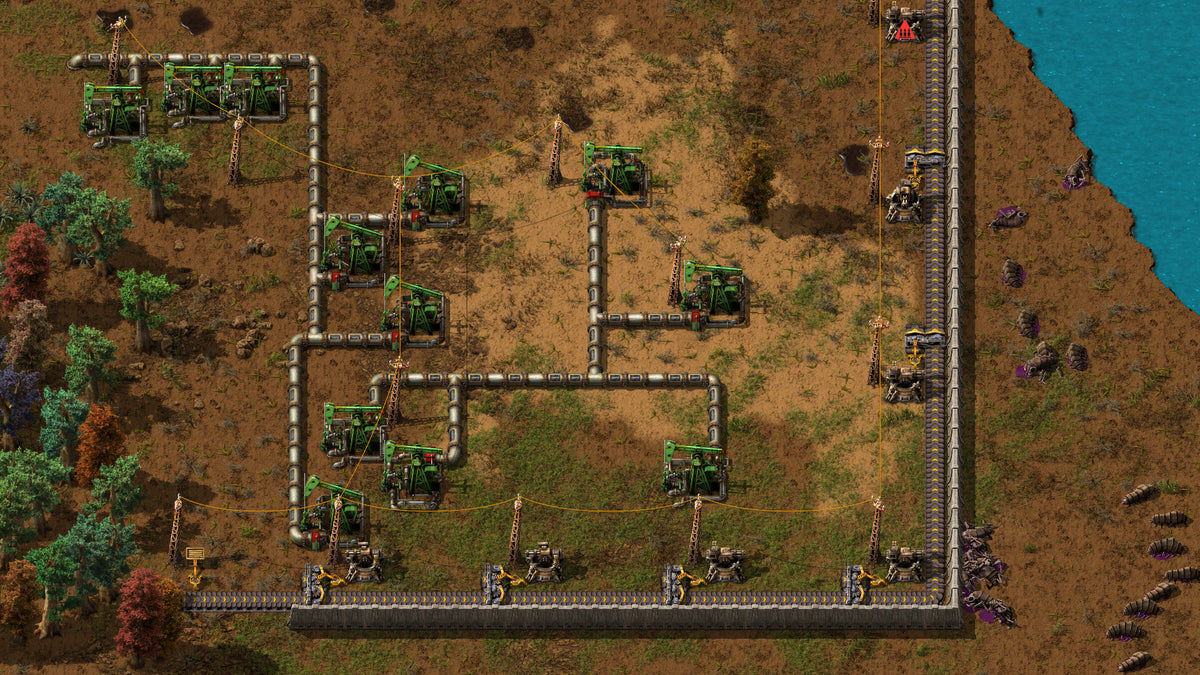
Featured image: oil extraction, pipes, power connections and a perimeter wall in an archival Factorio PC screenshot. © Wube Software.
A new research project in Factorio hands your factory another shopping list. Clicking the technology is easy. Keeping its laboratories supplied is the part that changes the shape of the place.
That makes research more than a reward screen. In the unmodded PC base game, it gives production a direction: something specific to make, feed and keep making. That progression runs from the first assembling machine to the rocket silo.
The first assembler changes what you are responsible for
Wube's game overview lays out the basic chain: drills extract ore, furnaces smelt it, assembling machines make products, and belts and inserters move materials between jobs. The interesting leap is connecting those jobs. A machine placed beside another machine is still only a pair of machines until the materials can reach the right destination.
The first assembling machine is available through Automation technology. It can produce many items, including another assembler, but cannot use fluids in its recipes. That limitation gives the early machine a clear place in the larger system. It opens the door to automatic manufacturing without pretending to be the final answer to every recipe.
Think about the difference between wanting one item now and wanting a continuing supply. For a one-off task, doing the work yourself can feel direct. A production line is a commitment to repeat the job. The useful question becomes whether you expect to need that output again, and what you want to spend your attention on while it is being made.

Science gives the factory a customer
Automation science packs, often called red science, are the first science-pack tier. Labs consume science packs to perform research, and research unlocks technologies with new recipes and bonuses. Progress therefore has a material cost that lives out in the factory.
That is a useful design choice. A technology tree can otherwise become something you visit between the interesting jobs. Here, supplying the next project is one of those jobs. The icon on the research screen points back toward ingredients, machines and delivery. The next unlock gives your existing production a reason to change.
It also makes a distinction between a factory that can demonstrate a recipe and a factory that can sustain it. Producing a handful of science packs proves that the ingredients came together once. Keeping labs supplied asks whether the arrangement can keep repeating that success. The difference is easy to miss when the first finished item feels like the whole achievement.
For a new player, that is a better way to read a complicated-looking research goal: follow one requirement back through its dependencies. You do not have to understand every future technology before choosing the next useful job. Start with the part of the demand you can explain, then work outward.

Electricity turns a local build into a shared problem
The official electricity documentation describes power being distributed to machines that need it within a network. A steam setup uses boilers supplied with water and fuel, while solar panels generate during daylight. Those are different arrangements to support, not merely different pictures beside the same power number.
The design consequence is that a new production area can depend on infrastructure well outside its own footprint. You may be concentrating on the machines beside a lab, but their operation belongs to a larger network. A neat-looking local arrangement cannot be judged entirely by looking at its local ingredients.
That is where Factorio starts asking for a wider view. An expansion is easier to understand when you can name the system it relies on and the demand it adds. It is tempting to judge progress by how much new machinery fits in a screenshot. A more useful measure is whether you can explain what keeps that machinery working.
The rocket brings the earlier lessons together
The base game's rocket silo is tied to the win condition and space science. Constructing the silo requires items such as electric engine units, processing units and concrete. Some required production cannot be completed by simply handcrafting everything from raw materials, and the rocket itself is made in the silo.
That gives the destination a different meaning from finding a final object on a map. The earlier manufacturing work is part of getting there. A successful launch represents connected production rather than just possession of one impressive building. This discussion concerns the base game; Space Age changes the rocket's role and progression.
The appeal, in our view, is the growing distance between wanting an outcome and understanding how to supply it. Early on, that distance can be one recipe. Later, it can be a network of dependent jobs. The game gives you a concrete destination, then lets your factory become your explanation of how to reach it.

Choose the next problem you can actually describe
There is no single layout being recommended here. A broader way to approach the game is to choose a production goal, identify what feeds it, and check what the surrounding factory must support. The point is to understand the new demand before expanding farther.
Our Factorio oil-processing guide takes a narrower look at one production problem. This feature is about the larger progression: research keeps handing the factory a new customer, and building a reliable supply is what turns an unlock into something useful.
Make room for the next game with Zypher
For Factorio information, editions and developer resources, visit Wube's official Factorio site. For your next console game, browse Zypher's video games and check each listing's platform, edition, condition and included items. Moving games along first? Our sell-your-old-games page explains current eligibility and terms.
Feature checked November 13, 2026 against Wube's overview and the linked official Factorio Wiki documentation. Screenshots are official archival PC base-game press images, with capture versions unspecified. Mechanics descriptions follow the current linked PC base-game documentation. © Wube Software, used under its press-media permission.


