Psychonauts in the Rhombus of Ruin gives Raz a fairly serious mobility problem. The psychic acrobat who used to bounce through other people's mental landscapes is now caught in a rescue mission where changing what he can see matters more than executing the next jump.
That is a smart use of a familiar character. Clairvoyance already belongs in Psychonauts. Making it the way you explore a virtual-reality scene lets Double Fine change the shape of the game without handing Raz a completely unrelated toolkit. The missing platforming is a deliberate design choice, and understanding that choice makes this unusual chapter easier to appreciate.
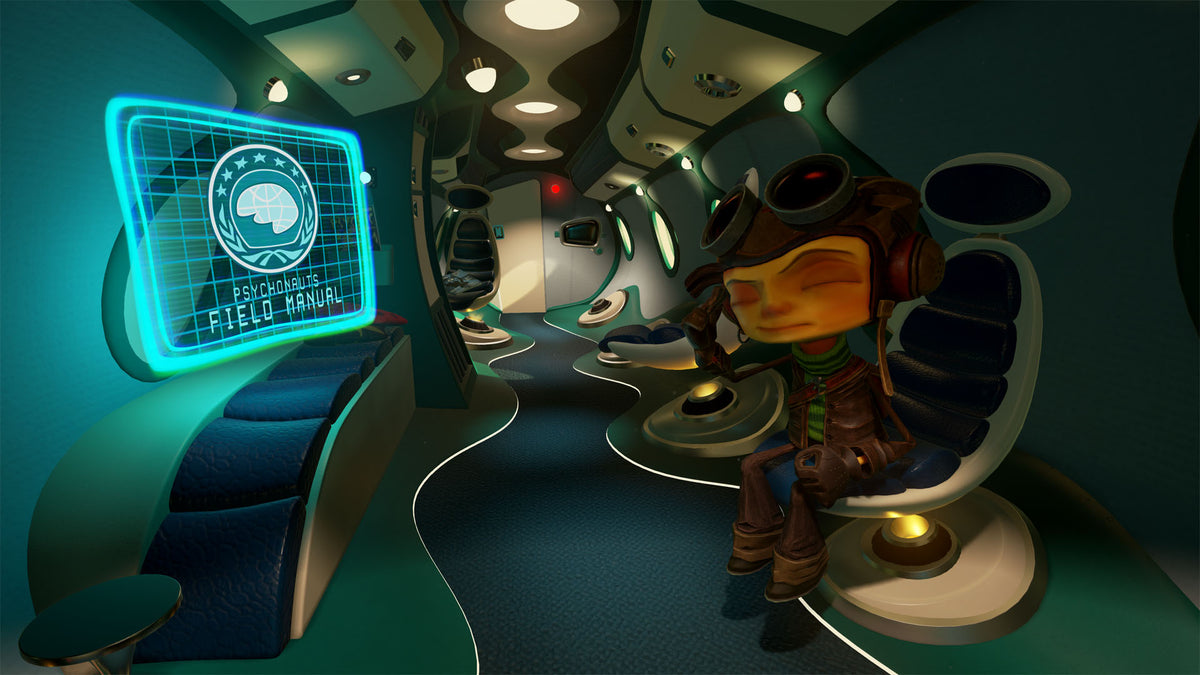
This is a look at the standalone VR puzzle adventure between Psychonauts and Psychonauts 2. The accompanying images are official PC-release in-game stills. They show the actual game, although a flat screenshot cannot reproduce the sense of scale inside a headset.

The rescue belongs between the two main games
Double Fine's original announcement places the mission immediately after the first game's ending. Raz, Lili, Sasha, Milla and Coach Oleander leave to rescue Truman Zanotto. The rescuers then become prisoners themselves, leaving Raz to work through the predicament with psychic powers.
That setup gives the smaller game a clear reason to exist. It follows an unresolved situation rather than inventing a disconnected training exercise. For someone playing the series in story order, the sensible sequence is Psychonauts, Rhombus of Ruin, then Psychonauts 2.
Keep expectations attached to that role. This is a standalone adventure-puzzle chapter, not another full campaign built around the original game's acrobatic levels. Its appeal is spending time inside a very specific Psychonauts situation and solving the rescue from the viewpoints available to you.

Clairvoyance makes another character a useful place to stand
Seeing through somebody else's eyes is more than an amusing change of camera. In Rhombus of Ruin, it supplies a different angle on the environment. A detail hidden from one position can become readable from another. Before looking for a new object, consider whether you need a better view of the objects already present.
Project lead Chad Dawson described Clairvoyance as the team's answer to moving around the world in VR. Instead of transplanting the original game's fast camera, the designers built exploration around psychic shifts between characters. The choice links comfort, fiction and puzzle design.
A useful way to approach a scene is to give each viewpoint a job. One may help you survey the room; another may put a small detail closer to your attention. You are assembling a mental picture from several positions. Staring harder from the first position is not always the same as investigating.

Your powers change the scene as well as the view
The developer identifies Telekinesis and Pyrokinesis alongside Clairvoyance: move objects, affect the surroundings and, where appropriate, set things alight. Those verbs keep the adventure recognizably psychic even when Raz is not running down a corridor.
Our recommendation is to separate observation from intervention. First identify what a viewpoint reveals. Then consider which visible object might respond to a power. That makes the chain of reasoning easier to follow than rapidly trying everything on everything while forgetting which change you just caused.
This is especially useful when an interaction changes what another viewpoint can reveal. Treat the room as a connected space, not a succession of unrelated pictures. You can be physically stationary while your understanding of that space changes substantially.

A smaller Raz changes the way a conversation looks
Dawson also discussed the scale of conversations in first-person VR, describing the feeling of being a child looking up at an adult aboard the jet. That is a concrete design benefit of placing the player at Raz's eye level rather than hovering behind him.
The official images help show why the approach fits this series. The curved cabin, exaggerated faces and crowded machinery are still unmistakably Double Fine's world. Putting those shapes around a player can make an ordinary exchange do some of the work that a moving third-person camera once handled.
Our reading is that Rhombus of Ruin works best as a change in attention. Give characters and environmental details a moment before rushing to the next interaction. The game has traded some physical momentum for opportunities to inspect and inhabit the scene.

Buy the VR game your equipment can actually run
The 2017 announcement calls the initial release exclusive to PlayStation VR. That is a historical launch statement. The PC version arrived on Steam in April 2018, and its current page labels it VR Only, lists SteamVR support and specifies a gamepad, with Touch usable as a gamepad option.
Check those requirements against the actual headset and PC you intend to use. Owning Psychonauts or Psychonauts 2 does not supply the hardware for this separate game. Also read the current Steam client requirements rather than relying on the old Windows 7 line still present in the game's minimum specification.
For a PlayStation purchase, verify the original PlayStation VR setup and the exact software version separately. This feature does not establish support on another headset merely because its name includes PlayStation. A VR story chapter is a worthwhile curiosity only if your setup can actually open its door.
For fans with suitable equipment, the attraction is clear: a focused rescue that uses Raz's existing powers to make a different kind of adventure. Come for the missing story chapter; stay alert to the viewpoint doing the work.
Explore Zypher’s game shelves for your next strange adventure. Ready to pass an older one along? Sell your old games to Zypher, checking current eligibility and terms.
Sources: Double Fine’s 2017 launch announcement; Project lead Chad Dawson on VR design; Current PC requirements. Interpretation and practical recommendations are Zypher editorial judgment. Original image proportions retained; Zypher is an independent retailer.


