The pavement in Sunset Overdrive is useful mostly because it gives you something to leave behind. Rails, wires, walls and bounce points turn a city block into a route through a fight. Shooting is still important. Standing in one place to do all of it misses the invitation.
Insomniac’s adventure follows a survivor through Sunset City after a contaminated energy drink turns much of its population into mutants. That premise supplies the noise and color. The more interesting design choice is underneath it: the trip between targets is an active part of dealing with them.

A city built for the movement system
In a 2014 developer interview, Drew Murray described rebuilding the city around the team’s traversal system. That order matters. The movement was not simply attached to streets already designed for a conventional shooter.
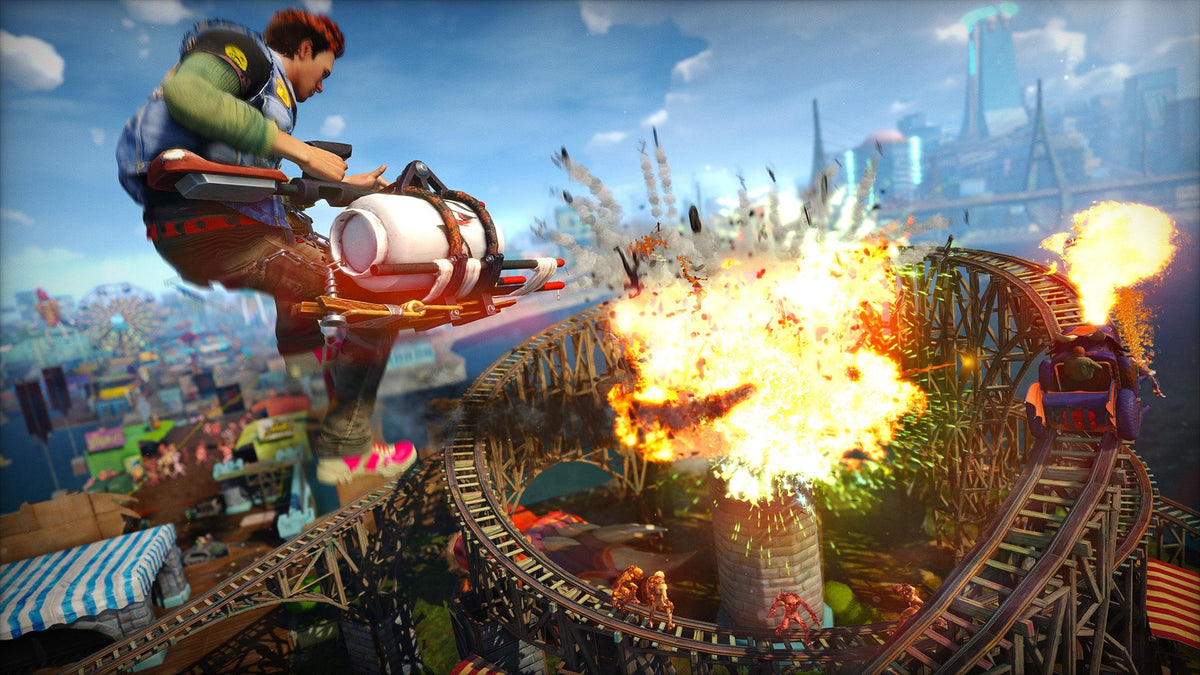
Look at the amusement-park scene above. Tracks create paths at different heights, while the ground remains full of activity. The useful question is not only which enemy to shoot. It is which line will let you keep moving, keep a view of the target and arrive somewhere useful afterward.
That changes how a familiar open-world task feels. Crossing a block can be a chance to learn an intersection rather than an empty interval before the next objective. A rail is transportation, but it also changes your firing position. A bounce point is an escape option, but it can also start the next attack.
Our advice for a first return is to spend a little time tracing a short loop. Pick a visible rail, a landing and a way back into motion. Then bring an enemy into that route. You will learn more about what the game wants from your hands than by treating every encounter as a reason to plant your feet.

Style does a job
The Xbox One manual explains the connection directly: staying off the ground while moving and fighting builds Style, and higher Style levels activate Amps. The meter turns a flashy approach into a functional one.
That is a smart reason to make movement readable. You need to understand not only where the character can go, but how to keep the sequence going while aiming. The reward is connected to maintaining that rhythm, rather than completing a decorative stunt after the dangerous part is over.
There is a learning cost. If you are accustomed to stopping behind a comfortable piece of cover, aiming and then advancing, Sunset Overdrive asks you to divide your attention differently. A moving route can feel like another thing to manage before it starts feeling like an advantage.
Keep the first route simple enough that you can still watch the fight. Losing track of the target while performing a magnificent tour of the neighborhood is not a requirement. A repeatable movement chain is a better foundation than an ambitious one that ends wherever gravity finds you.

The weapon is part of the route
The publisher’s PC listing describes an arsenal built from unlikely ingredients, including fireworks, harpoons, acid and dynamite. Its screenshots put similarly oversized machinery and bright weapon effects directly into crowded spaces.
These weapons make more sense when considered alongside the city. An effect that spreads across a group invites a different firing opportunity from a weapon you want to line up on one target. Height and direction become ways to set up an attack, instead of merely ways to travel to it.
Try looking at an encounter as a moving shooting position. Where will your view open up? Which part of the route leaves the target in sight? Where can you land without immediately losing the space you need? The answer can change with the weapon even when the street stays the same.
The manual also notes that leveling a weapon improves its statistics and adds an Amp slot. A weapon therefore has a development path beyond the moment you buy it. That gives you a reason to understand how it fits your movement, rather than only testing its first burst and putting it away.

Noise is useful when it communicates the hit
Sunset Overdrive’s crowded images can look almost unreasonable in a small thumbnail. An electrical effect crosses a crowd; a projectile leaves a bright streak; a yellow machine occupies much of the view. In motion, those distinct shapes and colors are part of the game’s vocabulary.
Our reading is that the exaggeration helps separate the jobs of the weapons from the ordinary geometry of the city. You are not being asked to admire a subtle puff of smoke and infer an entire combat system from it. The effect wants to announce itself.
That does not mean every bright effect will be equally readable to every player. If the action starts feeling difficult to follow, reduce the number of unfamiliar decisions you are making at once. Keep a known route while learning a weapon, or keep a familiar weapon while exploring a new route.
This is also why still images cannot tell the whole story of the traversal. A character hanging above a street is a moment in a sequence. The useful part is how the player got there and what can follow. The screenshot gives you the shape of the playground; the movement system gives those shapes a purpose.

Choose the edition around the experience you want
There is an important platform distinction before you plan a group night. The original Xbox One manual describes a solo campaign and an eight-player Chaos Squad mode. The current PC storefront presents Sunset Overdrive as a single-player release and includes the Mystery of Mooil Rig and Dawn of the Rise of the Fallen Machines expansions and a Weapons Pack.
Those PC inclusions are not a promise about a used Xbox One disc. Read the actual listing for the copy you are considering, and verify any digital entitlement separately. Likewise, the historical Xbox manual’s description of Chaos Squad is not evidence that a present-day online session is available or populated.
For a solo player, the central attraction remains the same relationship between routes, weapons and Style. If you want movement that keeps asking for your attention even between objectives, this is an unusually clear example. If you want the city to stay politely in the background while you shoot, it is going to keep interrupting that arrangement.

Give the next journey a better route
The satisfying progress to look for is specific: a rail you now notice, a bounce that gets you out of a bad position, a weapon you can use without losing the next landing. Sunset Overdrive makes those improvements part of the main activity, rather than side work you do before the adventure starts.
Check Zypher’s Sunset Overdrive Xbox One listing for the offered copy’s condition and contents. Browse more games for your next solo campaign, or sell your old games to Zypher when it is time to clear space.


