Bravely Default II asks you to think about storing turns for later. Final Fantasy XVI puts Clive's sword and Eikonic powers in your hands. Both belong in Square Enix's PC RPG catalog, but they promise very different evenings. This ranking is about finding the adventure whose decisions appeal to you.
What this Top 25 covers
These are 25 released, single-player RPGs published by Square Enix and available on PC through the linked Steam listings, checked November 11, 2026. The ranking weighs party-building, combat decisions and the structure of the journey. The order reflects Zypher's editorial judgment. It favors interesting party choices and a strong reason to keep following the journey; it is not based on a poll or aggregated review scores.
Each game appears once. A remaster names the edition we mean; Final Fantasy VII Remake and Rebirth count as distinct games. Final Fantasy X is ranked on its own even though the PC package also contains X-2. Numbering across this list does not imply a single continuous story. Follow the specific sequel notes below, and check each listing's current PC requirements before buying.
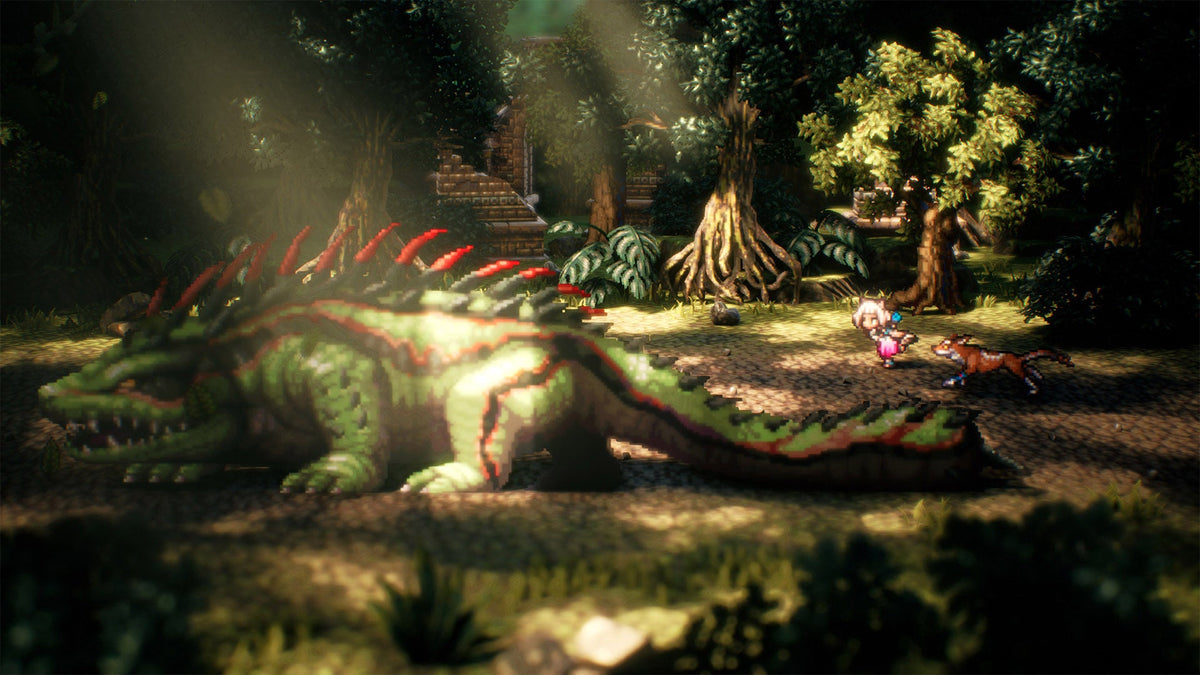
Featured image: Ochette faces a large creature in Octopath Traveler II. © SQUARE ENIX CO., LTD. All Rights Reserved. Official press capture, unaltered; the publisher does not identify its capture platform. The article's screenshots illustrate the two Octopath games, not every ranked title.
25. Final Fantasy II (Pixel Remaster)
Final Fantasy II earns its place by making character growth depend on how you fight. That is a more interesting reason to revisit it than simply filling a gap between I and III. We would start here when experimenting with unusual progression sounds fun. For a first encounter with the series, though, its development rules add another thing to learn alongside the adventure.
24. Final Fantasy (Pixel Remaster)
Four crystals, a party of adventurers and a world that opens up with an airship: the original keeps the attraction easy to understand. We rank it below the more elaborate party-building games because this list rewards variety within a long adventure. Choose this 2D remaster when you want a relatively clear fantasy premise rather than another cast member arriving with an entire family dispute.
23. Final Fantasy XIII
A group of strangers becoming enemies of the state gives XIII a strong source of urgency. The floating world of Cocoon and the party's struggle against a prescribed fate are the draw here, supported by battles that mix action and strategy. The cinematic story is the attraction we would buy it for. XIII-2 continues this saga with a different time-travel premise, so check which adventure you actually want before choosing between the similar names.
22. Final Fantasy III (Pixel Remaster)
Changing jobs lets the same adventure become a different party-building exercise. A Dragoon or a summoning role offers a reason to reconsider a team that seemed settled. This entry means the 2D Pixel Remaster, not the separate 3D remake. We place V higher for its skill combinations; III is the pick when the basic pleasure of changing professions is enough to keep you tinkering.
21. Final Fantasy XVI
Clive's sword techniques and Eikonic abilities put the appeal squarely in action combat. Choosing which powers to learn and improve gives the spectacle a useful layer of ownership. The tradeoff is party control: his human allies act for themselves, while Torgal can take commands. If you came for directing a full squad's turns, several higher entries make more sense. Come here for Clive's fighting style.
20. Final Fantasy XV Windows Edition
The road trip gives XV an unusually clear social shape: a journey with friends, with an open world and action combat built around Noctis's warping and team attacks. Warping into a fight gives the trip a burst of action between stretches of traveling together. It sits lower because our ranking favors more deliberate party configuration. Check the Windows Edition listing's included content rather than assuming every later extra is bundled.
19. Final Fantasy XIII-2
Returning to a location in a different era can change its scenery, wildlife and circumstances. That makes time travel an actual reason to explore, rather than a date stamped on the loading screen. Recruiting monsters adds another party-building attraction. The sequel status matters, though: we would start with XIII if following this particular saga is the goal. Pick XIII-2 for revisiting places that refuse to stay the same.
18. Lightning Returns: Final Fantasy XIII
A world running out of time makes planning the route part of the premise. Lightning's outfits change her abilities, and the game concentrates its fighting around her rather than a conventional party. We like that commitment to a different structure. The obvious buying consideration is that this concludes the XIII saga. Its clock and solo focus are reasons to choose it deliberately, not assume it plays like XIII with new clothes.
17. Chrono Cross: The Radical Dreamers Edition
Two parallel worlds give Serge's journey a strong reason to revisit the familiar, and the large recruitable cast invites curiosity about who belongs on the team. The included Radical Dreamers text adventure also gives this edition an extra narrative avenue. We place Trigger higher for its party-combination appeal. Choose Cross when a sprawling set of possible companions and an alternate-world mystery sound more inviting than a tighter core group.
16. Final Fantasy VIII Remastered
Junctioning magic to stats makes spells useful before anyone casts them. An acquired spell can strengthen a character's attributes as well as serve as a combat command. That gives collecting magic a purpose beyond stocking the next fight. Squall and Rinoa's relationship supplies a different kind of focus. That unusual use of magic is also the buying consideration: allow some time to understand Junction before judging the party by its levels.
15. Octopath Traveler
Eight travelers and eight regions of Orsterra turn choosing a route into part of the appeal. Path Actions give characters something useful to contribute outside the next fight, while battles reward exploiting weaknesses. Collecting stories and abilities along the way is the reason to pick the original. Its eight-character structure is also the commitment: choose it when moving between separate personal journeys sounds enjoyable, rather than wanting one lead to carry everything.

14. Final Fantasy IV (Pixel Remaster)
Cecil's doubts about serving Baron give IV a strong starting conflict, while companions such as Kain, Rosa and Rydia bring recognizable roles to the party. Active Time Battle brings a timing element to choosing commands. We rank it above the earlier numbered games for that blend of character-led drama and battle rhythm. V is the better choice if rearranging jobs matters more to you than following this particular cast.
13. Final Fantasy VII Rebirth
Rebirth takes the remake project beyond Midgar into a much wider journey, including travel across open areas on chocobos. Its strongest invitation is to spend more time with this version of the cast while exploring beyond the city. It is the second game in the remake trilogy, not a substitute for starting with Remake. That extra commitment keeps it below the more self-contained starting points here.
12. Bravely Default II
Default stores Brave Points; Brave spends them to take multiple actions. That makes a turn feel like a decision about the next few turns, rather than merely selecting the strongest attack available now. Combining a main job with a secondary job adds room to experiment. We like the interaction enough to rank it highly, but it asks you to learn that rhythm. Its new world and cast make the sequel number less intimidating.
11. Triangle Strategy
Convincing your allies before a major vote makes political decisions feel like part of managing the group. Utility, Morality and Liberty influence the course of the story and the people who join you, giving this tactics RPG a strong identity beyond winning its battles. The tradeoff is the attention those decisions deserve. Debating a direction and living with it is a substantial part of the appeal; make room for those conversations between battles.
10. Final Fantasy VII Remake Intergrade
Mixing real-time movement with command decisions gives Remake a useful middle ground between action and party tactics. Intergrade also includes Yuffie's INTERmission episode, so the edition name means something concrete. Its concentrated Midgar setting is why we rank it above Rebirth as a starting purchase. The limitation is equally concrete: this is the first part of a larger remake project, not the entire original VII story.
9. Bravely Default Flying Fairy HD Remaster
Brave spends BP to take more actions, while Default strengthens defense and saves BP for later. That creates a useful choice between acting now and preparing a stronger response. We rank this remaster of the first Bravely Default above II for the appeal of returning to Tiz and Agnès's crystal quest in Luxendarc. Pick II instead if you want its new cast and world; these are separate adventures, not alternative editions of one game.
8. Final Fantasy IX
Learning abilities from equipment makes an old piece of gear worth a second look. Once an ability is mastered, it remains available without the item, which gives equipment decisions another purpose besides chasing a larger number. Zidane's troupe and Garnet's escape add a lively starting point. We rank IX this high for combining a distinctive cast with approachable customization; V still offers more appeal when experimenting with jobs is the priority.
7. Dragon Quest XI S: Echoes of an Elusive Age, Definitive Edition
Turn-based combat and the option to experience the adventure in 2D or 3D make this a welcoming place to settle into a substantial quest. Draconian Quest options let you change the challenge, while this S edition includes additional character material. We favor it for the flexibility around a traditional RPG structure. That same structure is the consideration: choose XI S when you want to enjoy familiar rhythms, rather than have every system reinvented.
6. Final Fantasy V (Pixel Remaster)
V is the one we would choose when a new ability immediately suggests a new combination. Jobs and inherited skills give experimentation a clear payoff: learning something in one role can help shape a later setup. Bartz's crystal quest supplies the adventure, but party construction is why it climbs this list. If you mainly want a cast's personal drama to dictate the next session, IV or VI may be a better fit.
5. Final Fantasy XII: The Zodiac Age
The Zodiac Job system gives building a party a firm structure, while hunts offer goals beyond the next story destination. We like that pairing: decide what the team should do, then find another reason to put it to work. Ivalice's conflict around occupied Dalmasca gives the journey a political frame. This is the PC Zodiac Age remaster, so a listing for the original PS2 game is a different purchase with different systems.
4. Final Fantasy VI (Pixel Remaster)
An ensemble whose members bring their own stories makes VI a strong choice when the group matters more than a single hero. Magicite lets characters learn spells and gain access to summons, adding a shared customization system around those individual identities. We rank it this high for that combination. The Pixel Remaster is a modern 2D edition; buy an original cartridge for collecting that release, not because the two editions are interchangeable.
3. Final Fantasy X (through X/X-2 HD Remaster)
Tidus accompanying Yuna on a pilgrimage against Sin gives X a strong sense of purpose before the larger mysteries need explaining. We place it near the top because that journey makes following the party itself a reason to continue, rather than treating story as the space between battles. The PC purchase contains X and X-2; only X occupies this rank. If unrestricted wandering is the priority, our preference for its focused pilgrimage may not match yours.
2. Chrono Trigger
Combining two or three characters' abilities into a single technique makes party selection matter in a wonderfully direct way. Time travel supplies a second reason to keep changing the scene, from the distant past to the future. That connection between companions, combat and an unfolding journey earns our runner-up spot. The PC edition also includes the Dimensional Vortex and Lost Sanctum dungeons; it is not a literal reproduction of an original SNES cartridge.
1. Octopath Traveler II
Day and night change Solistia, and each traveler's Path Actions create reasons to interact with townspeople beyond asking where the next dungeon is. Add jobs, skills and the Break and Boost battle systems, and building a party becomes useful both in and out of a fight. That breadth wins this particular ranking. Eight personal journeys require attention, though. Choose our number one when several threads sound like an invitation, rather than an obligation.


Prefer these adventures on your shelf?
Zypher also lists the separate physical PS1 edition of Final Fantasy VIII and PS1 edition of Final Fantasy IX. Those are PlayStation games, not the PC versions linked in this ranking. Check the current condition and included items on the listing before ordering. To make room for another RPG, check Zypher's general Buy List and sell your old games.
Edition and gameplay references: the publisher-managed Steam pages linked at each rank; VIII director Yoshinori Kitase on Draw and Junction; and Square Enix's XVI battle overview. Images: Square Enix's Octopath press gallery, reproduced for related editorial coverage under its press terms. Ranking and recommendations are editorial opinion.
Correction, November 11, 2026: rank nine now covers Bravely Default Flying Fairy HD Remaster. The older Final Fantasy VII PC listing was removed from this selection because it is no longer sold on Steam.


