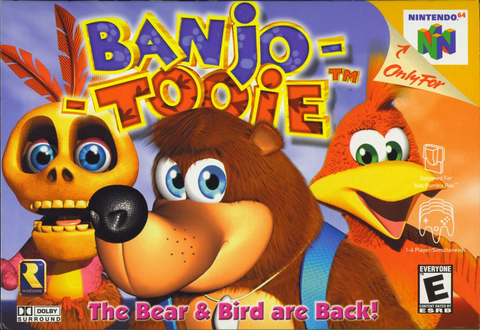
The backpack looks like a permanent arrangement. Banjo-Tooie gets much more interesting when you stop treating it that way. A bear and a bird sharing one silhouette can enter a place that neither can fully solve alone.
Rare's Nintendo 64 sequel asks you to remember routes, return with different abilities and sometimes put one half of the duo somewhere the other cannot go. Its spaces become easier to read when you track the character and movement problem alongside the location.

Learn what is missing before hunting another switch
The original N64 manual organizes Jamjars' lessons by world. It also makes an important starting point clear: the pair begin with their first adventure's moves, and Spiral Mountain offers refresher lessons. A returning player can reacquaint themselves with the basics; a newcomer does not need to guess which familiar-looking move is already available.
When you encounter an obstacle, ask what sort of action would address it. A ledge is a movement problem. A target can be an aiming or ammunition problem. A route that only one character can use may require separation. Treating all three as a hunt for a nearby button creates a lot of unnecessary laps.
A short note can help: location, obstacle and suspected requirement. Write “high ledge near entrance” rather than “finish mine.” The first note tells you what to revisit after learning a move. The second merely reminds you that a whole world still exists.
Split-Up Pads change who the player is
Jamjars' Witchyworld lesson introduces splitting up. On the original N64 controls, stand on Banjo's Split-Up Pad and press A. Control can switch at the appropriate pad or a Swap Spot. Bringing the characters into contact reunites them.
That creates a useful planning habit: before sending one character away, identify where you expect to swap control and how you will bring the pair together again. Separating is more purposeful when you have a job for each character, rather than an assumption that the faster-looking one should explore everything.

Their solo abilities underline the distinction. Banjo can wield the empty backpack with Pack Whack. Later lessons give it more specialized uses, including Taxi Pack for carrying things. Kazooie's solo movement develops in a different direction, including Leg Spring and Glide. These are reasons to reconsider a familiar space, not simply more attacks to remember.
Use the warp network as an exploration tool
The manual explains that a world needs at least two discovered Warp Pads before you can travel between them. Stand on a pad, press B, choose an available destination and confirm with A on the N64 layout.
Make activating and recognizing those endpoints part of your first pass. A useful route can be worth more than another minute of searching an isolated corner. It makes later visits less cumbersome and gives your notes a practical reference point.
There is also a pacing benefit. Once you can return to an area efficiently, leaving an unresolved obstacle feels less like abandoning progress. You can pursue a newly learned ability and come back with an actual plan. The game has enough going on without making every return trip a memory test.

Eggs are tools, not interchangeable ammunition
Tooie's manual gives different eggs different jobs. Fire Eggs can illuminate dark paths and ignite enemies. Ice Eggs freeze enemies. Grenade Eggs explode. Clockwork Kazooie Eggs let you steer a small mechanical bird before detonating it or reaching its timer.
The useful habit is to check the selected egg before firing. On the original controls, R cycles the available types after the ability is learned. First-person aiming provides another way to inspect and address a target; the Breegull Blaster areas go further and make that viewpoint central.
Aiming, selecting ammunition and understanding a target are separate tasks. Slow down enough to distinguish them. Missing with the correct tool is a different problem from accurately firing something that cannot produce the result you want.

Mumbo gives you another route through the same world
The manual's Mumbo Pad instructions specifically require the shaman to be standing on the pad before activating its magic. A pad therefore means something different from a generic switch the duo can press during an ordinary lap.
Record those locations as a separate kind of opportunity. When you later control Mumbo, a remembered pad is a destination with a purpose. The same principle applies to unusual forms and traversal sequences: look for what the current body can do, rather than demanding that every situation behave like ordinary Banjo-and-Kazooie platforming.

Keep one useful goal for each return visit
A practical session might have one immediate objective: connect another warp destination, revisit a ledge with a new move, or test the correct egg against a known target. That gives the larger adventure a manageable shape without turning it into a rigid walkthrough.
Music notes also support progression through Jamjars' requirements. A route that gathers notes and connects useful locations can be productive even when it does not end in a Jiggy. The point is to notice what the trip accomplished rather than judge every stretch of play by the same collectible.
Our take: Tooie's satisfying complexity comes from reinterpreting places. A room can be an egg challenge, a solo-character route or a future magic destination depending on what you know. If you keep that possibility in mind, an unfinished corner becomes an invitation with a requirement attached.

Choose your version and controls deliberately
The control references here come from the original North American N64 manual. Later versions and controller layouts need their own button mapping. Nintendo's October 2024 announcement also highlights independent bear-and-bird exploration and interchangeable eggs in the Switch Online release.
For an original cartridge, check Zypher's Banjo-Tooie N64 listing for its specific condition and contents. If you are making shelf space, see how trading and selling to Zypher works.