Hidden Dreams, The Grimm Troupe, Lifeblood and Godmaster are four free content packs for the original Hollow Knight. The names can look like a complicated shopping list, but Team Cherry presents them as expansions to the same game.
Their names also do not describe four identical bundles of extra rooms. One emphasizes a new quest and characters, another changes existing encounters, and another leans into demanding boss content. Knowing that difference helps you decide what kind of return to Hallownest sounds appealing.
This is a spoiler-light comparison of those four packs, not a route to every secret or a purchase guide for Hollow Knight: Silksong. The screenshots show the original Hollow Knight. Where an image provides general world context rather than a particular pack's content, the caption says so.
Hidden Dreams: another reason to take a familiar world seriously
Hidden Dreams added two boss encounters, a hidden stag station and Dream Gates. Team Cherry's launch post describes the gates as a new way to travel through Hallownest. The pack therefore changes both the challenges you can seek and the business of moving around a familiar kingdom.
Those additions serve different moments in a return visit. Another boss offers a reason to sharpen your combat, while another travel option matters when the next objective is on the other side of the map. It is a broader set of additions than simply putting two more opponents at the end of the game.
You do not need to turn a first playthrough into an audit of which update supplied which detail. Follow the game in front of you. The pack names become more useful when you are deciding what to investigate after a return, rather than interrupting every discovery to identify its release history.

The Grimm Troupe: look for an experience with its own identity
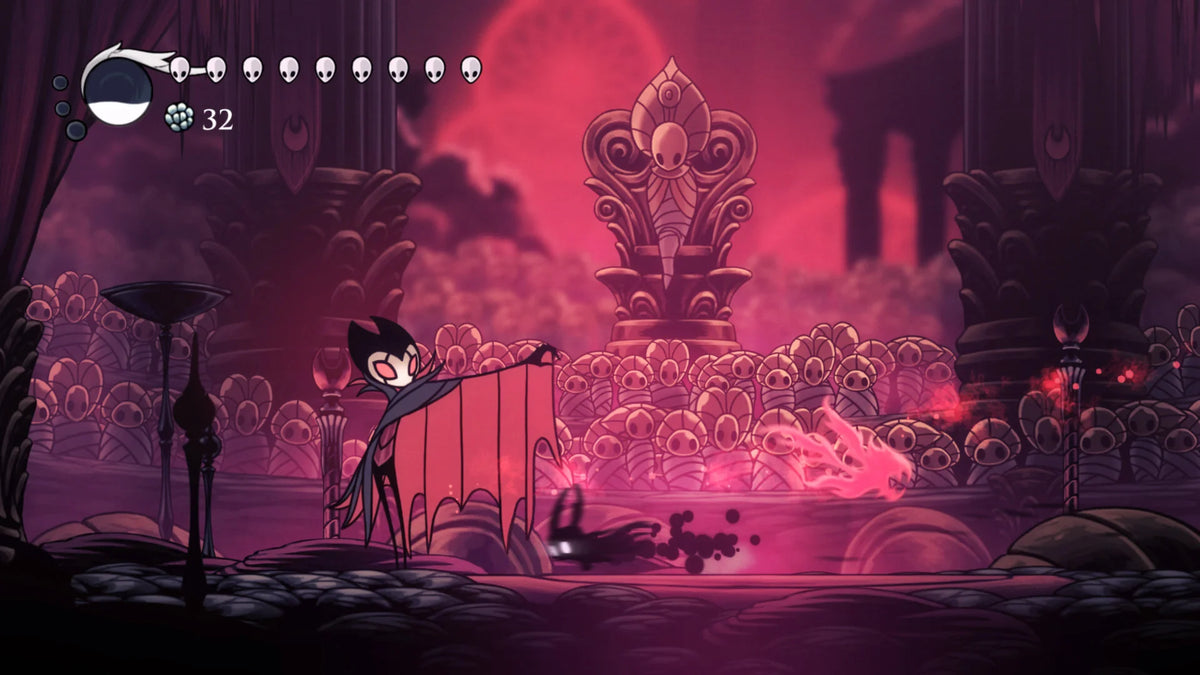
The official description of The Grimm Troupe emphasizes a major quest, boss fights, charms, enemies and characters. Its red stage-like imagery gives that list an immediately different personality from the quieter blue and green spaces elsewhere in Hallownest.
That makes it a sensible pack to investigate when your interest is as much in the world and its unusual inhabitants as in another mechanical test. A quest can give individual fights a setting and a reason to exist beyond being one more challenge left on a checklist.
Keep the distinction between discovering a quest and following a completion route. If you prefer finding the game's surprises yourself, start with the broad premise and leave the detailed instructions closed. If you have already explored extensively and want to find a particular thread, a focused route can be useful without turning the whole return into a spoiler tour.

Lifeblood: an expansion can improve existing material
Lifeblood's launch notes include custom map markers alongside a new boss, a substantially upgraded boss and refinements throughout the game. Map markers are a particularly practical addition to remember: keeping track of a place you want to revisit is a different benefit from having another fight waiting there.
For a returning player, the practical implication is that an old memory is not always a complete description of an encounter. Take a moment to look at what the fight is doing now, rather than insisting it conform to a route you remember from an earlier version.
For a newcomer, those refinements are simply part of the experience you encounter. There is no requirement to reconstruct an older release to understand why the current one works. Update history can explain a change; it does not need to become another assignment before you play.

Godmaster: decide whether boss-focused play is the appeal
Team Cherry introduces Godmaster with new characters, a new quest and new boss fights. Its golden arena imagery makes a useful contrast with the exploratory spaces shown in the other captures. The emphasis is much more concentrated than the feeling of wandering through a newly encountered area.
That distinction helps set expectations. A player who enjoys learning demanding encounters has a different reason to return from someone who mostly wants to explore unfamiliar scenery. Both interests are legitimate, and a free addition does not become an obligation just because it is available.
Team Cherry's Godmaster launch post explicitly warns that it contains some of the game's greatest challenges. Take that as useful expectation-setting. If you want a concentrated combat project, this is a different invitation from setting off to map another corner of the kingdom.

Keep the buying question separate from the playing question
Before paying for any package, match the exact game, platform and stated included content. The original Hollow Knight's four free packs are not evidence that a differently named product, soundtrack or sequel is included in a listing. A store description should do that work explicitly.
Once the correct game is installed, the more interesting decision is how you want to spend your time with it. New fights, a distinctive quest, revisions to familiar material and a more concentrated challenge are different invitations. You can accept the one that suits the evening without promising to finish every other thread first.
Our earlier Hollow Knight feature discusses the broader relationship between the small protagonist and the surrounding world. This comparison has a narrower purpose: helping the pack names mean something before you plan a return.


Put another adventure on the shelf
Browse Zypher’s physical game collection for your next adventure. Have games to move along first? Check the general Zypher Buy List and match each item to its exact system and contents.
Sources and image credits
- Team Cherry: the original Hollow Knight and its four free content packs
- Team Cherry: Hidden Dreams launch
- Team Cherry: Lifeblood launch and map markers
- Team Cherry: Godmaster launch
- Team Cherry: published media permission for game owners and press
Unaltered official Hollow Knight website gameplay images, used with original commentary under Team Cherry’s published media permission. Capture platform and build are unspecified. Small originals retain their native dimensions. Sources and store links checked November 15, 2026. No publisher endorsement is claimed.


