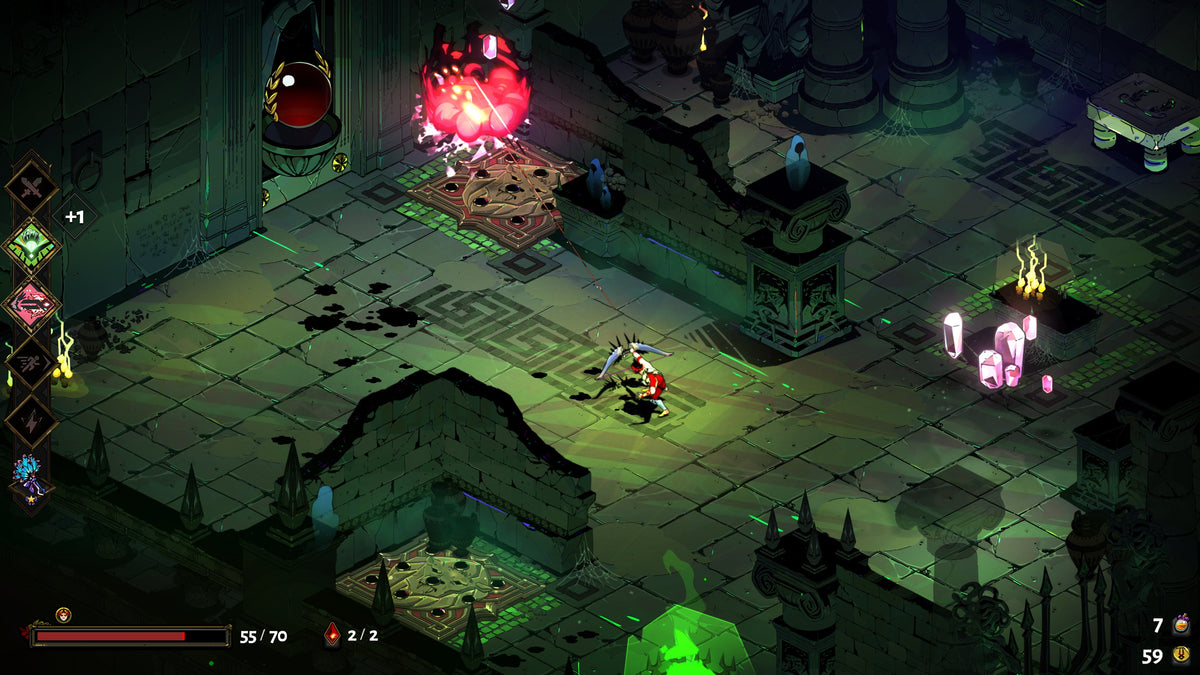
An unsuccessful escape in Hades ends with Zagreus back in the House of Hades. That could have been a loading screen with furniture. Instead, it puts the next attempt inside an ongoing family argument.
The distinction matters if repeated runs usually leave you cold. Hades asks you to improve at its fights, but it also gives those fights a place in a larger routine. Battle, return, talk, reconsider, leave again. The destination stays appealing while the starting point keeps changing its meaning.
This feature covers the original Hades, not Hades II. Supergiant's first game in the series reached version 1.0 in September 2020. Its appeal is less about having a perfectly optimized build ready before you begin and more about making useful decisions with the powers, opportunities and problems an attempt actually presents.
A weapon changes the question before a boon answers it
Look at the official bow-combat capture: Zagreus stands apart from the enemy, with the chamber's pillars and open floor between them. That is a different visual problem from the close-range fighting shown elsewhere in the publisher's images. Range does more than change a damage number. It changes which pieces of the room deserve your attention.
If you tend to approach every encounter by rushing toward the nearest target, a weapon with a different reach gives you a reason to reassess that habit. Where can you attack from? Which enemy is making that position unsafe? Where will you move after the attack? Those questions are useful before any discussion of a perfect combination of upgrades.
The game's divine boons then complicate the answer. Supergiant describes the Olympians as offering powers that combine in different ways across attempts. A sensible first goal is to understand what a new choice changes in the actions you are already using. A spectacular effect is less useful if you never make room to use it.

The gods have opinions about helping
An Olympian's appearance is also a conversation. Athena's portrait and dialogue occupy the same screen as the chamber in one of the official captures. Assistance arrives with a personality attached, rather than feeling like an anonymous upgrade menu dropped over the action.
That presentation gives the build-making a different texture. You are choosing combat tools, but the people providing those tools also have a place in Zagreus's world. A player interested primarily in fighting can concentrate on the effect. A player following the relationships has another reason to pay attention to who is speaking.
For a new run, resist turning every unfamiliar offer into a research project. Read the effect, connect it to an action, and notice what happens in the next fight. You can make more precise comparisons once the terms mean something beyond a paragraph in a guide. There is a difference between knowing that a combination exists and knowing why it suits the way you move.

Read a room before treating it as a damage test
The Asphodel capture makes the point quickly: solid ground and surrounding lava divide the available space. The danger is partly about enemies, but the floor also has something to say about where a fight can happen.
Try separating three observations after a rough encounter. First, identify the attack that hurt you. Second, identify the position you were standing in. Third, identify the action that kept you there. A different boon might help, but so might entering the encounter with a clearer idea of where to move.
For the next encounter, change the part you can identify: move away from the edge sooner, attack from a different distance, or let the target come to a safer piece of ground. Blaming the whole build gives you much less to work with than noticing that the same chase keeps ending in lava.

Returning to the House does not erase the story
Supergiant built Hades around recurring characters who remember Zagreus across attempts, with permanent progression alongside the changing runs. That is the crucial link between its action and its structure. Losing an attempt need not leave the surrounding narrative exactly where it was.
The House also gives the game a change of pace. In the official capture, Hades sits behind his desk while shades queue through a large interior. It is a workplace as well as a home. After crowded combat rooms, that arrangement is almost comically administrative. Apparently leaving the Underworld still requires dealing with management.
Give that quieter phase a little room. If your only measure of a session is how far the last escape reached, you can miss the value of the conversations and decisions between attempts. Conversely, if a conversation is what brought you back, you do not need to pretend the combat was merely an obstacle. The two parts keep giving each other reasons to continue.

Familiar faces can become combat problems
The official Megaera dialogue capture shows a character encounter inside an arena. Another shows the Minotaur and Theseus sharing a fight. These are useful images of the game's basic trick: a named personality can matter both as someone in the story and as a presence that changes how you read a room.
That connection makes preparation more interesting than simply collecting stronger equipment. When you recognize a character, you bring expectations into the encounter. The fight then asks whether those expectations help you understand what is happening, or distract you from the immediate attack.
For learning, pick a smaller goal than winning the entire attempt. Watch one threat, preserve a usable position, or learn which part of an encounter is causing the most trouble. An attempt can fail while still answering a question you carried into it. The game does not need you to call every loss a secret victory. Sometimes it was just a loss. A specific observation makes it less likely to be the same loss next time.


Choose the difficulty and version that fit your plans
The original Hades is a single-player game. Supergiant's FAQ also describes God Mode, which increases resilience to damage and becomes more forgiving after deaths, alongside other ways to adjust the challenge. Using an available setting is a practical choice about the experience you want, not a claim about anybody else's preferred difficulty.
Version details deserve the same straightforward treatment. The publisher supports PC and Nintendo Switch cross-saves, while its Xbox and PlayStation versions do not share that PC cross-save feature. If moving between platforms is the reason for buying another copy, check that distinction before assuming every version behaves alike.
Make room for your next adventure
Browse Zypher’s physical games and match the platform and included contents to your setup. If you are clearing shelf space, check Zypher’s general sell-your-old-games page for your own titles.
Sources and image credits
- Supergiant: Hades FAQ
- Developer-published Hades store description
- Supergiant: official Hades media bundle
Official Supergiant Games media supplied through its Hades media bundle. Dated 2019 captures show pre-1.0 promotional builds; exact capture platform and build of the other images are unspecified. Images remain unaltered. Gameplay interpretation is Zypher editorial analysis; no personal playtest is claimed. Sources and store links checked November 15, 2026. No publisher endorsement is claimed.


