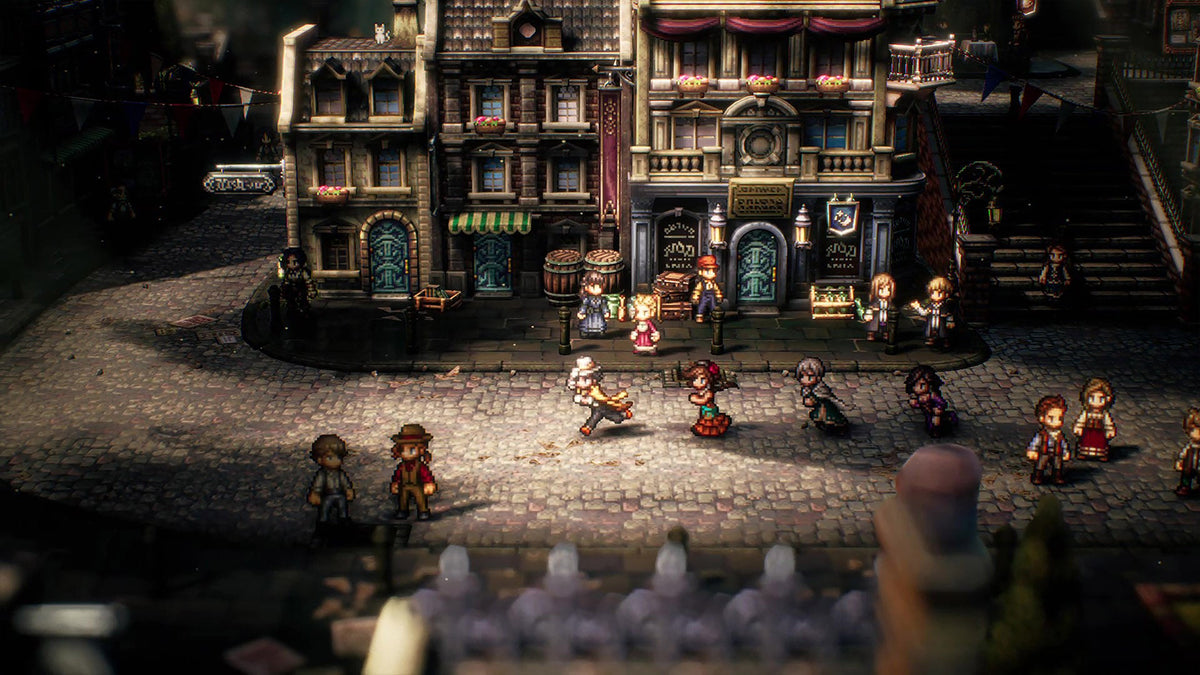
A town in Octopath Traveler II deserves a second visit before you leave it. Switch from day to night and you change more than the lighting: each traveler has a different Path Action available. The person standing nearby can become a new opportunity, even when your party has not gained a level.
That is the change worth examining between the first two Octopath games. Both build an adventure around eight protagonists, but the sequel makes the time of day another part of choosing how to approach a place. This feature looks at those two games specifically, with light examples of their systems and no story-ending spoilers.
Featured image: a party in a shopping street in Octopath Traveler II. © SQUARE ENIX CO., LTD. All Rights Reserved. Official press screenshot, unaltered; capture platform unspecified.
The first game gives the party a life outside battle
The original Octopath Traveler introduces Orsterra through eight travelers and their personal stories. Their Path Actions give each protagonist ways to interact with people, so the distinction between party members extends beyond the attacks on their battle menus.
We like what that does to the act of entering a town. Talking to everyone can be a routine RPG habit. Giving a character a particular way to deal with an NPC adds a second consideration: who should approach this person? An ability that matters on the street gives you another reason to care about who is traveling with you.
It also creates a useful connection between exploration and party-building. A companion can be interesting because their story appeals to you, because their combat abilities fit a need, or because their interactions open a different possibility in town. Those reasons can pull in different directions. That is a more engaging decision than treating the group as interchangeable sets of equipment.

Solistia adds a second set of possibilities
In II, the setting changes to Solistia, with a new cast and a standalone story. Producer Masashi Takahashi explicitly describes it as a game you can begin without playing the original. You do not need to complete an Orsterra itinerary before being allowed into the sequel.
The important mechanical change here is that each hero has two Path Actions, split between day and night. The world and its people also change with the time of day. Instead of asking only which character suits the situation, you can consider when to approach it.
That gives revisiting a place a different purpose. A return trip can be about trying a changed set of interactions, rather than repeating a shopping stop. Our recommendation is to treat the two times of day as two views of a location. Take a moment to inspect what is actually available before deciding that you have exhausted its possibilities.
Buying an item and taking it are different approaches
Takahashi gives a concrete example: Partitio can buy an NPC's item, while Osvald can mug that person at night. The desired object may be the same, but the character and action used to obtain it differ.
The useful lesson is to examine the action's requirements before committing. We would not assume that two ways of pursuing an objective demand the same resources or preparation. Read the prompts, inspect the situation and choose the method that fits your current party. There is no need to turn every encounter into a fight simply because a combat option exists.
This is where the sequel's extra layer earns its place. The day-and-night switch gives you another way to reconsider a problem. It can encourage a pause to look at the people around you, before heading back out of town.

The travelers have different reasons to be on the road
The cast's aims also create contrasting reasons to move through the same world. Agnea wants to become a star. Osvald wants to find the person responsible for his imprisonment and suffering. Castti is trying to recover her memory. Those are not variations of a single shared assignment.
For us, that contrast is the attraction of the eight-story structure. Moving between travelers changes the question driving the next chapter. It is also the commitment to understand before buying: several personal stories mean several threads to follow. A player who prefers one protagonist and one central objective may want a different kind of RPG.
II adds Crossed Paths stories between protagonists as their journeys progress. That is an additional form of connection, rather than a reason to pretend the first game had no interaction between its characters. The difference matters when describing what the sequel actually changes.

Keep the familiar combat, reconsider the town
Break and Boost return in II. Enemy weaknesses remain useful to exploit, while boosting strengthens your travelers' actions. The sequel also adds Latent Powers, special abilities whose gauges fill during combat. Those additions give battles their own changes without replacing the series' central identity.
The town systems deserve attention alongside them. A party can be worth changing for what it can do between fights, and a place can be worth revisiting because night offers a different approach. That is the specific reason we would return to Solistia: to notice another use for a familiar traveler, rather than simply chase a larger damage number.
Pick an adventure, then check the edition
The Steam links above identify the separate PC games. Check the current platform and edition before buying a physical copy elsewhere. You can browse games at Zypher for your existing systems, or use Zypher's general Buy List to sell your old games and make room for another adventure.
Sources: the publisher-managed Steam listings linked above; producer Masashi Takahashi's explanation; Square Enix's feature overview; and the official systems page. Design interpretations and recommendations are Zypher's editorial judgment. Screenshots supplied through Square Enix's press gallery under its editorial press terms.


